
Hakone, which overlooks Mount Fuji is just 60 miles from Tokyo and hence a popular day trip from the capital. However, if, like us, you are planning to continue your travels east from Tokyo, it makes sense to stay here overnight. In addition, the town is renowned for its Onsen hot spring baths. So, for me, an overnight visit is all part of the experience.
How to get to Hakone
It is possible to take a direct regular train and a direct express train (The Express Romancecar) to Hakone-Yumoto from Tokyo’s Shinjuku Station. Note: The Romancecar isn’t included in the JR Pass. The alternative option (free for JR Pass holders) is to catch the Tokaido Shinkansen bullet train from Tokyo Station to Odawara, then a local train to Hakone-Yumoto.
Getting around Hakone
Hakone’s main attraction is the Hakone Loop; a circuit which consists of a mountain railway, funicular railway, cablecar and pirate ship, with a bus back to the start. The loop starts with the Hakone Tozan Railway, which departs from Hakone-Yumoto Station.
The Hakone Free Pass, which covers all the transport options listed above, can be purchased for a two or three day period. If you are travelling by bullet train to Odawara, this can be obtained at Odawara Station and costs ¥6000 (£28) for 2 days. If you are travelling from Tokyo Shinjuku, the pass costs ¥7100 (£34) for 2 days. This includes the basic train from Tokyo. If you want to take the Romancecar, there is an additional surcharge of ¥1200 (£6) each way.
Where to stay in Hakone
We stayed at the Hakone Forest of Verde; a large hotel complex with the most spectacular underground hot baths. Highly recommended!
Hakone in 1 Day Itinerary
| Day 1 | Bullet Train to Odawara Hakone Tozan Railway Hakone Cablecar Hakone Ropeway Owakudani Crater Lunch at Owakaduni Crater Hakone Ropeway (Part 2) Hakone Pirate ship Moto-Hakone (Torii Gate) Accommodation: Hakone Forest of Verde Dinner at Yunessun |
Bullet Train to Odawara
At Tokyo Station, we board the bullet train to Odawarawa, where we pay to leave our suitcase overnight at the tourist information office. Here we also purchase Hakone Free Passes. These provide 48 hours of unlimited use of all the various transportation options Hakone has to offer.

Hakone Tozan Railway
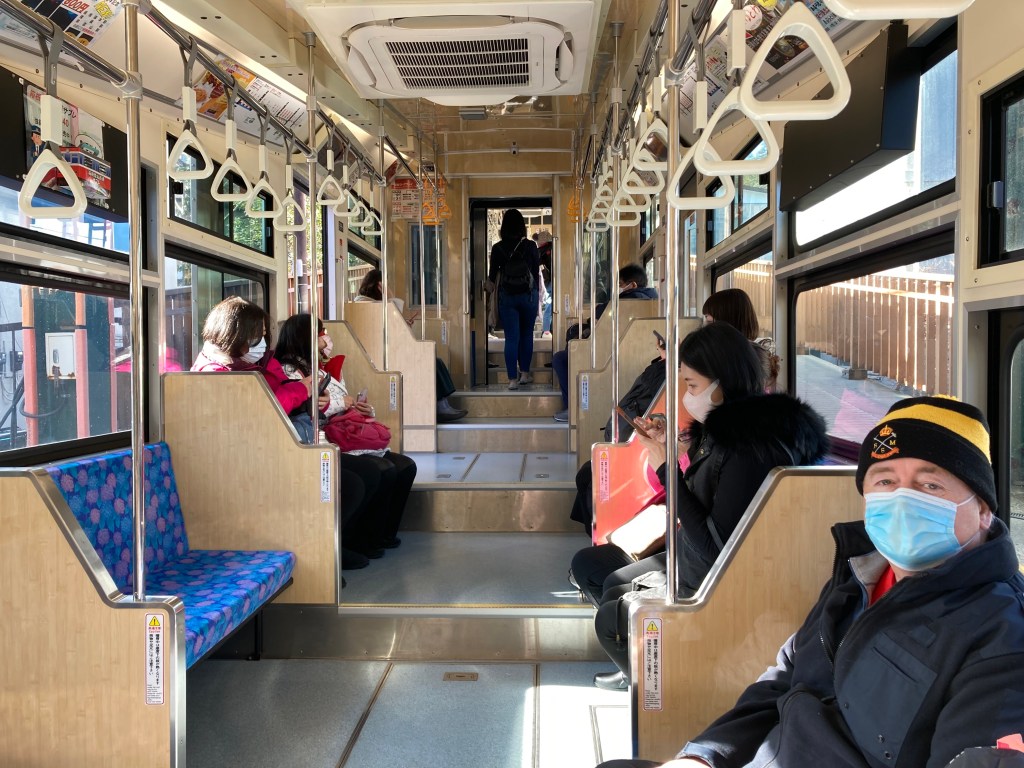
First, we must take a local train for 4 stops to Hakone-Yamato, where we transfer to the Hakone Tozan Railway for our journey to Gora. We select a forward facing seat, and set off up the mountain. Not the best decision, as we soon reach a switchback. Once the driver has run from the front of the train to the back, and the conductor vice versa, we set off again, this time in the opposite direction. After two more switchbacks, the train makes it to Gora, which is at an elevation of 541 metres.
Hakone Cablecar
From here, we continue to Sounzan via what the Japanese call a cablecar, but I would describe the Hakone Cablecar as a funicular railway. This 10 minute journey takes us to an elevation of 740 metres. Even the platforms are at a slant, which makes disembarking tricky, as we climb to the exit for the next stage of our journey.

Hakone Ropeway
The Hakone Ropeway is, theoretically, a 4 km gondola ride from Sounzan to Togendai over Owakudani crater. As part of the line was under maintenance when we visited (and let’s face it, who wants to ride a poorly maintained cable car over a volcano?) we had to take a replacement bus for the first leg of the journey to Owakudani. This is rather disappointing as we miss the most dramatic part of the trip where the car passes through the sulphurous steam belching from crater of the volcano.
Owakudani Crater
At Owakudani Crater, we get our first proper view of Mount Fuji. We’re lucky to have chosen a lovely day for our visit and apart from a little bit of cloud, we can see the volcano in its full splendour.
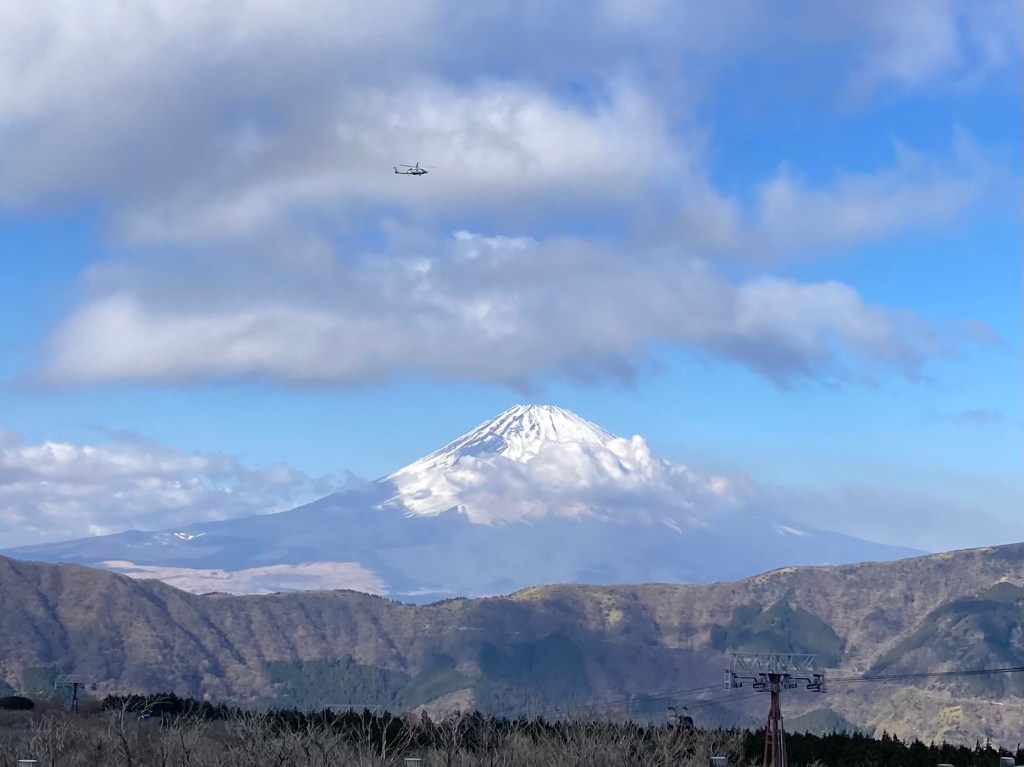
All around the ropeway station at Owakudani sulphurous steam bellows forth from the volcano below. Which makes for some spectacular scenery, although the smell is somewhat less spectacular.

Lunch at Owakudani Crater
The place’s USP is hard boiled eggs which have been cooked in the volcanic steam, thus turning the shells black. Obviously, we can’t resist purchasing some eggs (¥500 for 5). The old man also has a black ice cream.

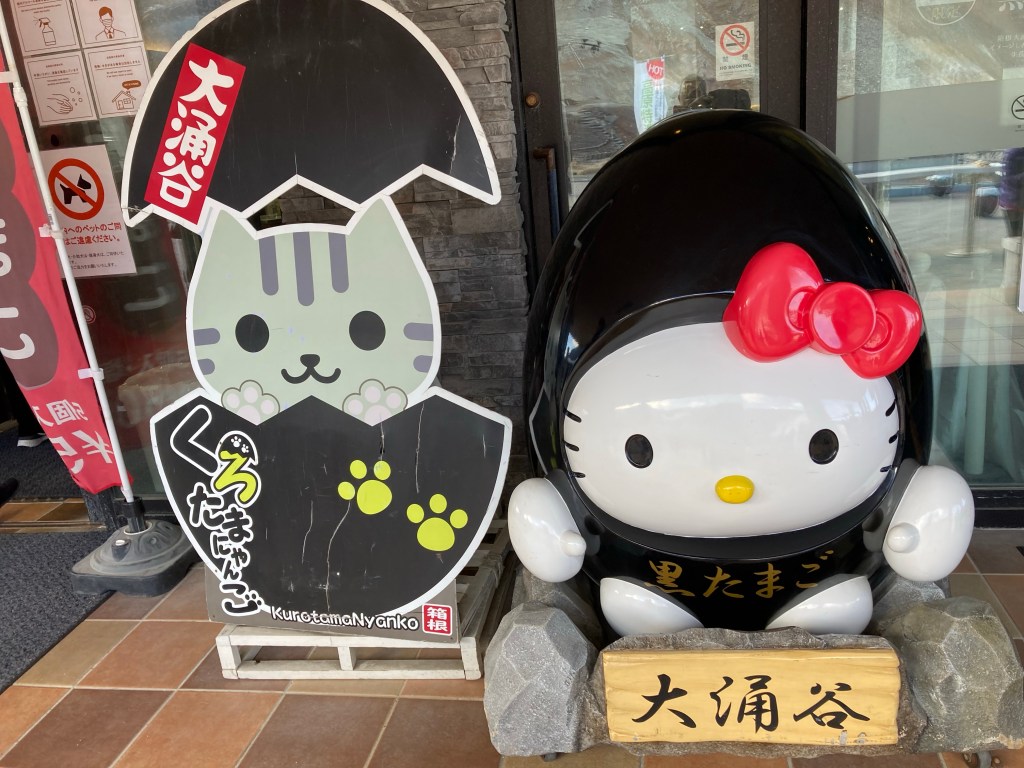
We eat our weird picnic sitting on some black egg shaped stools watched over by Hello Kitty who is hatching from a black egg.

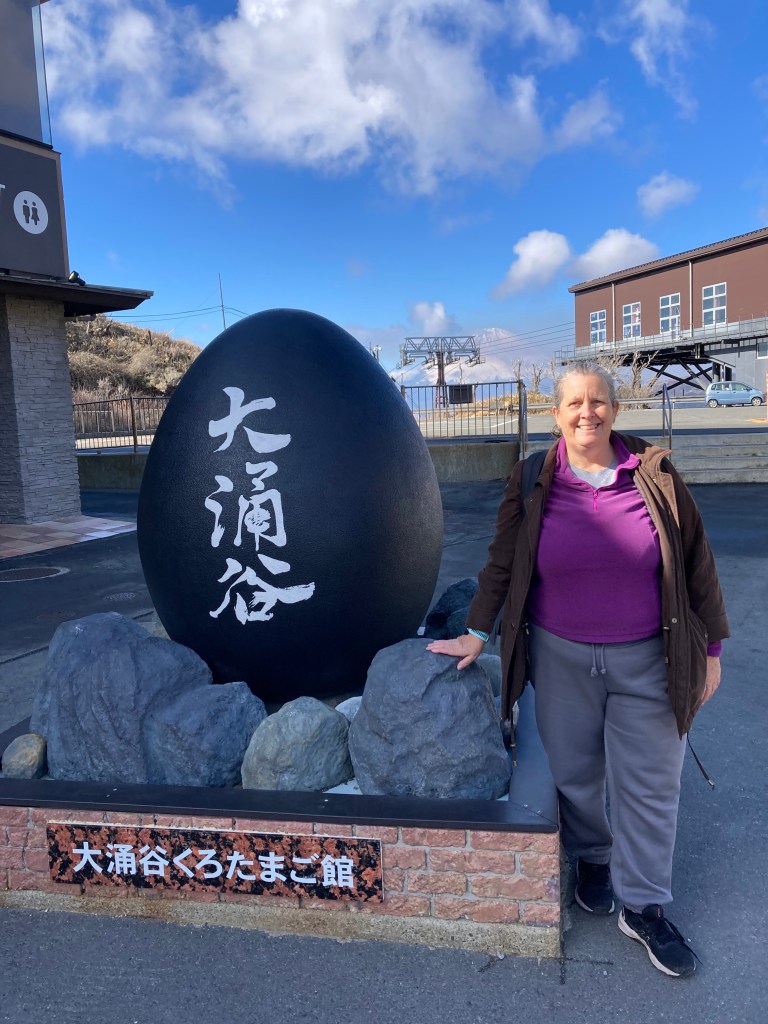
After the obligatory selfie with the black egg sculpture, we board the Hakone Ropeway which will take us down to Tendegai on the shores of Lake Ashinoko.
Hakone Ropeway (Part 2)
The 30 minute downhill Hakone Ropeway journey takes you to Lake Ashi, offering views of both the lake and Mount Fuji along the way.
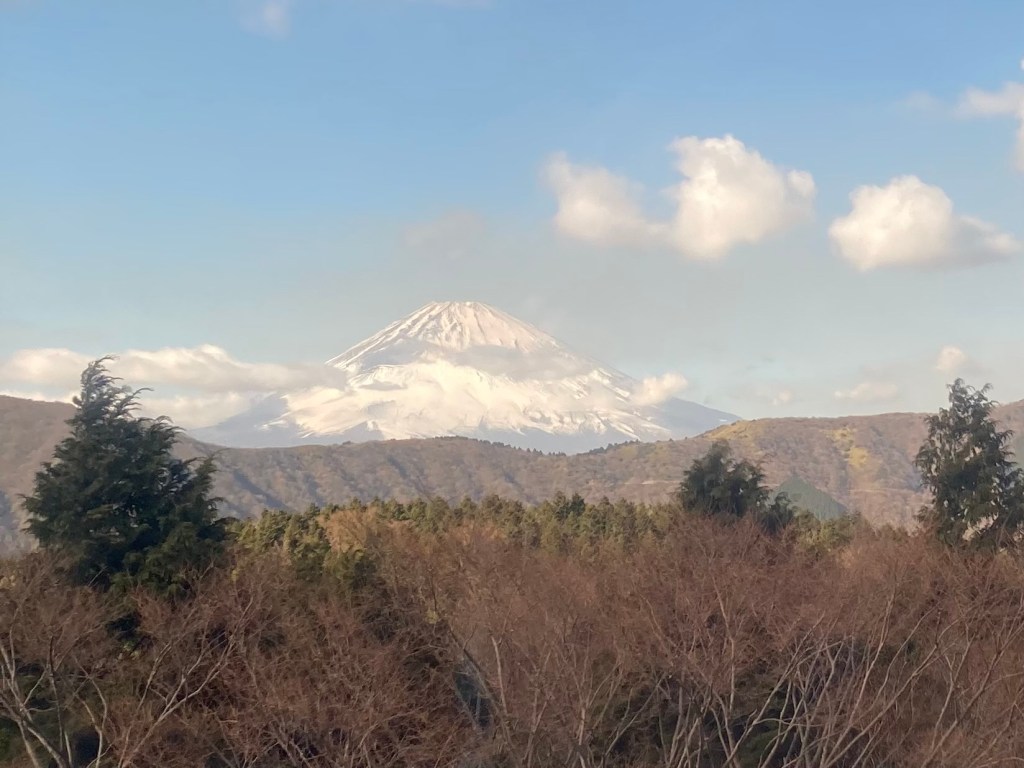
We have some time to take a wander along the shores of Lake Ashi before taking a pirate ship ride across the lake.

Hakone Pirate ship
I’m not sure what the significance of the pirate ship is – did pirates used to frequent inland glacial lakes? But it’s definitely a pirate ship, complete with cannons and a treasure chest full of life jackets. The Hakone Pirate Ship sails from Togendai on the north of the lake to the south shore, stopping at Hakone-machi and Moto-Hakone before returning to Togendai.
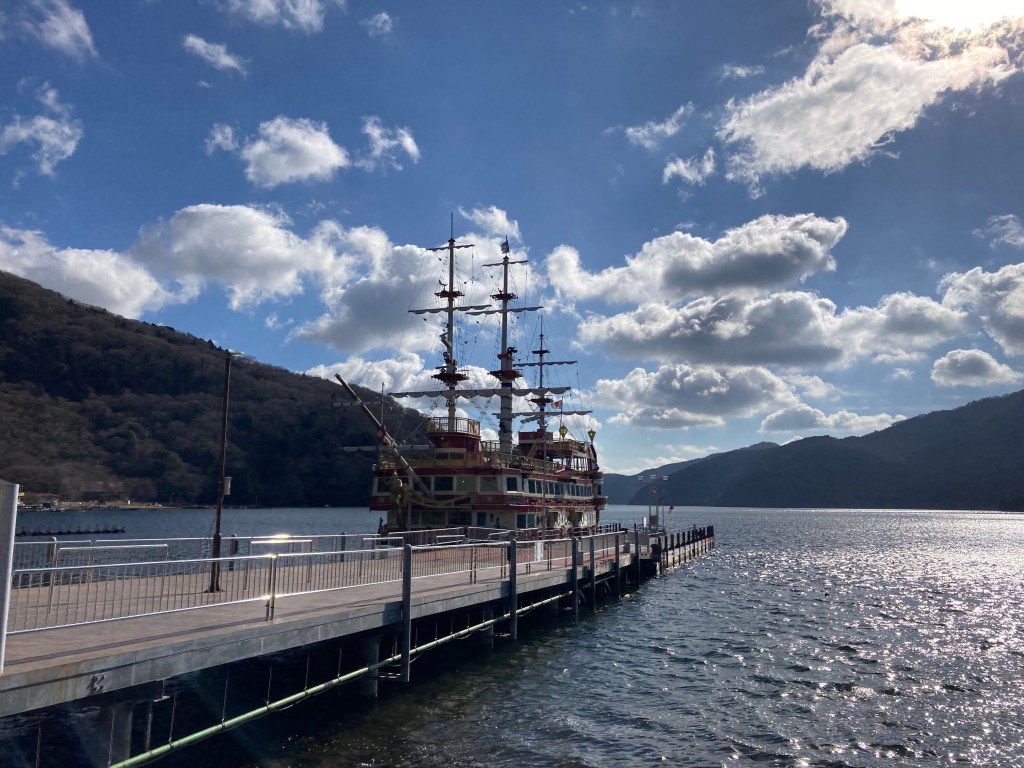
Close to the stop at Hakone-machi is Onshi Hakon Koen; a park which provides awesome views of Mount Fuji.

Moto-Hakone
At Moto-Hakone, you can visit a shrine with a torii gate rising from the lake.

Instead of completing the full tourist circuit by bus, we decide to remain on the pirate ship, returning to the north of the lake for a second cablecar and funicular ride. The nearest station to our hotel is at Owakudani, part way down the funicular line. An announcement states that there is no way to cross the line here, so to ensure to exit the correct side. So we at the mercy of Google maps (and my navigational skills). Luckily, neither let us down. All we have to do now is walk for 15 minutes down a narrow, winding road with no pavement to reach the hotel.
Accommodation – Hakone Forest of Verde
It’s rather remote and when we arrive at our accommodation for the night; Hakone Forest of Verde, I think we’re mistaken as it looks very industrial. It also looks very deserted. Just after we complete our mountainous walk, taking our lives in our hands on the windy pavementless roads, the shuttle bus from the station pulls up. The hotel runs a regular free shuttle from the station – who knew? Obviously not us! The enormous hotel is very quiet. It’s a bit like checking in to the Marie Celeste.
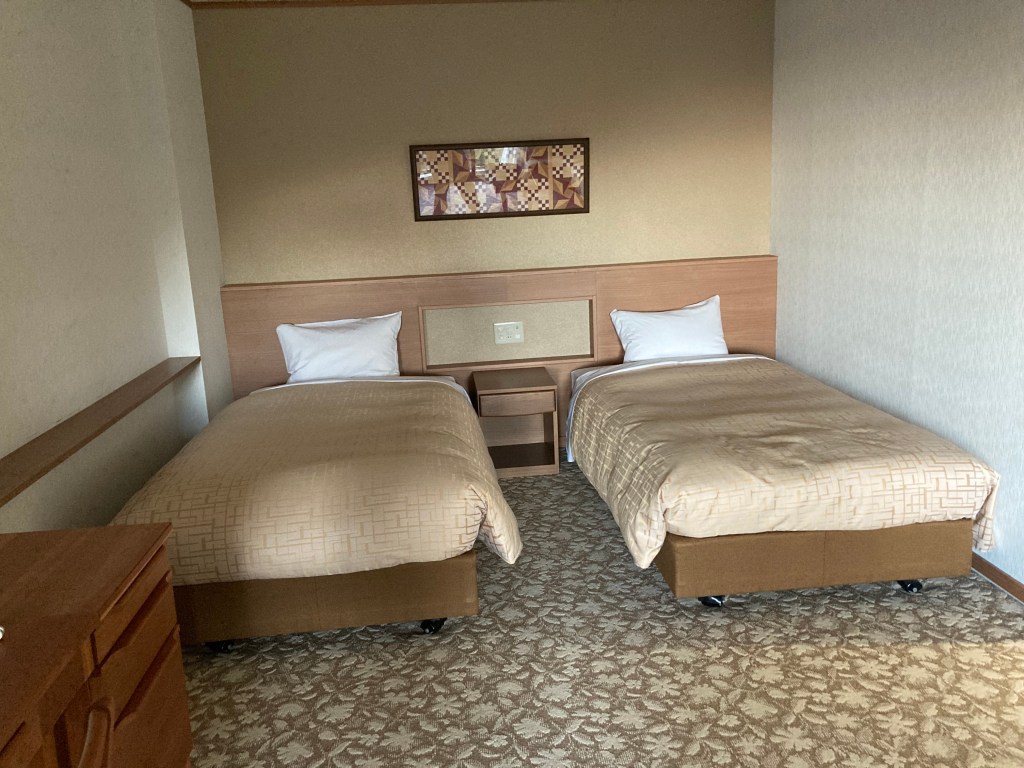
From our room on the 6th floor we have a balcony with a pretty cool view across the mountains.

It turns out that the ‘industrial’ look comes from the fact that the hotel is built on a series of hot springs, with machinery regulating the emissions. The building is split into two wings, each with its own series of hot spring baths. Our wing has nine hot springs (5 for men and 4 for women). So while the old man is catching up on his candy crushing, I go to investigate the baths.

The room is like Dante’s Inferno. The springs bubble away into their respective pools. There’s also some spring powered showers and a sauna. Technically, as the Japanese favour bathing naked, photography is prohibited, but as I have the place to myself, I figure it won’t hurt to take a few photos.

Dinner at Yunessun
As our hotel rather remote and the restaurant is closed, we ask the receptionist where to go for dinner. He says there’s only one restaurant within a half hour walk of the hotel; Momiji in the Yunessun Building. To reach it you must follow a passageway round the back of the hotel. Five minutes later you emerge at Yunessun, which turns out to be a hot spring/shopping mall combo. It also turns out that a set meal at Momiji costs £100 a head.
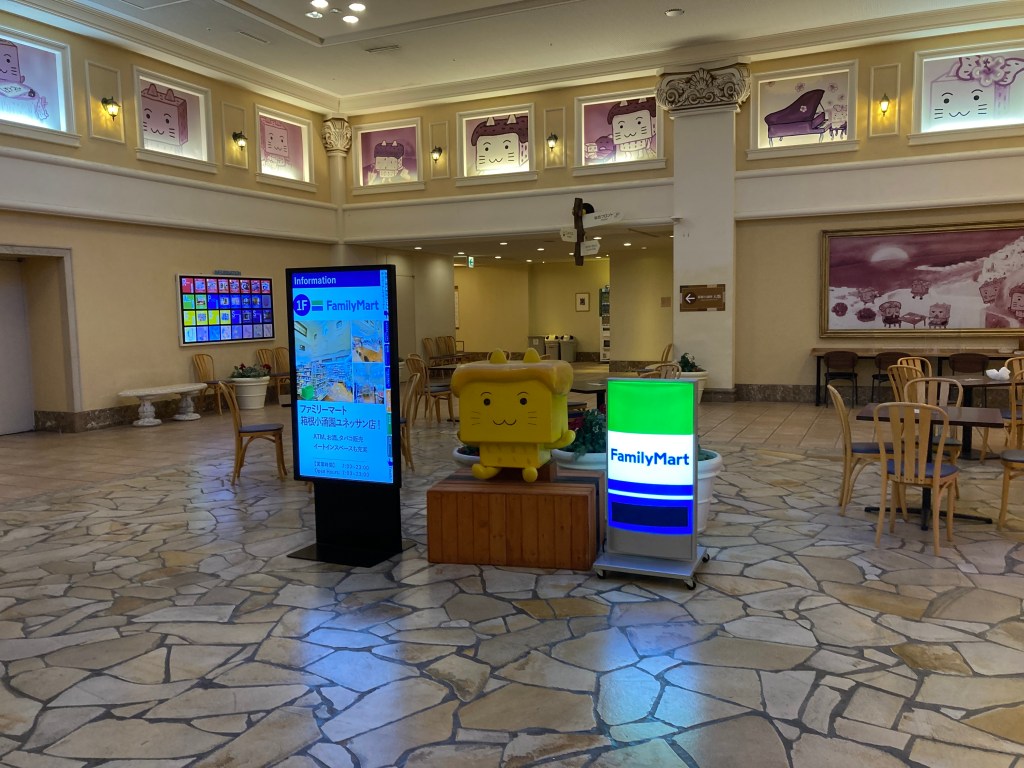
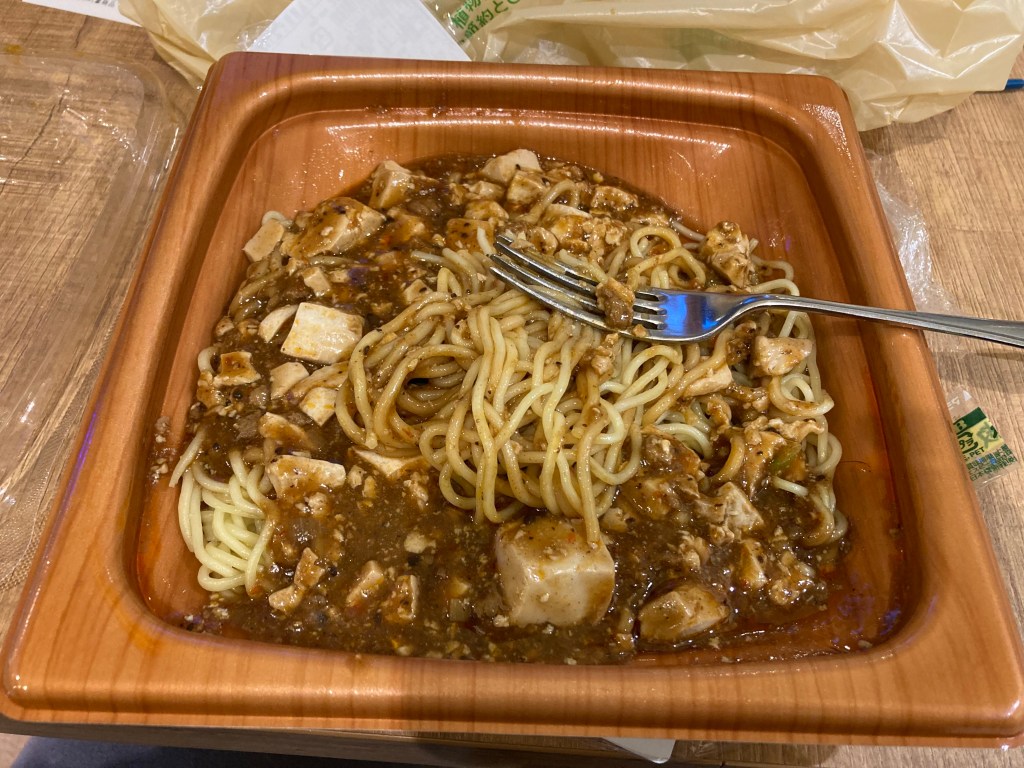
On the first floor we find a Family Mart convenience store with a dine-in area. Here, you can purchase ready made meals from the chilled cabinet and they will microwave them for you. It’s not exactly haute cuisine, but my spicy tofu noodles are actually quite tasty. And they certainly leave us with plenty of change from £100! Which is ample for the purchase of a few souvenirs at the mall gift shop before returning to our hotel.
Note: We didn’t visit the baths at Yunessan as we had our own at our hotel. However, if you fancy bathing in wine, or maybe coffee or honey, this is the place to go…
- Trip taken: January 2023
- Updated: March 2026
I hope you found the above information useful. For guides to more destinations in the 50+ countries we have visited, check out my full list of Independent Travel Itineraries here.
 Jane's Midlife Journey
Leave a comment