
We spent 2 days in Paraguay on our South American trip, crossing the border from from Iguazú in Brazil, then catching a bus from Ciudad del Este to the Paraguayan capital, Asunción. To be honest, of all the places we visited on our 3 months in South America, Asunción was probably my least favourite destination. Nevertheless, here is my itinerary for a couple of days exploring this rather underwhelming capital city.
How to get to Asunción
We travelled to Asunción by bus from Ciudad del Este and departed by plane for Buenos Aires. The bus terminal is 4 miles south east of the city centre. There are several bus operators. We used Nuestra Señora de la Asunción, which runs several services a day from Ciudad del Este, with prices starting at 110,000 guarani (around £11.40) for a single ticket. NSA also connect Asunción with several other destinations in Paraguay, as well as Argentina and Brazil.
The airport is 12 miles north east of the city. Theoretically, you can travel to/from the airport by bus. We booked a taxi. There isn’t a huge choice of flights; 15 destinations in 9 countries, primarily in South America, but also Panama City and Madrid.
Getting around Asunción
The city centre is compact enough to visit on foot. My city itinerary covers less than 2 miles. A walk to the Costanera and back would add another couple of miles, depending on how far you continue along the riverside.
Where to stay in Asunción
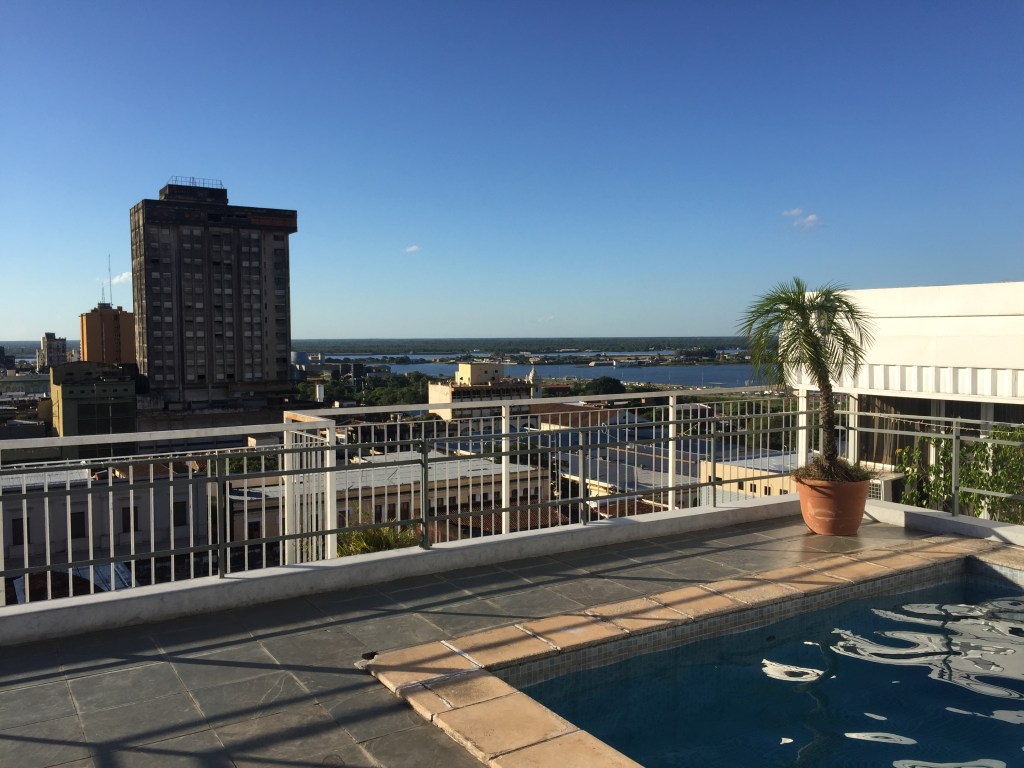
We stayed at the Hotel Chaco; it was a bit tired, but very centrally located and with a rooftop pool with a great view. I don’t think it’s still open – the last post on its FB page was a sale of hotel furniture…
Asunción in 2 Days Itinerary
| Day 1 | Bus to Asunción Accommodation Dinner at Lido Bar |
| Day 2 | Estación Central del Ferrocarril Plaza Uruguaya Catedral Metropolitana de Nuestra Señora de la Asunción Cabildo Plaza de Armas Casa de la Independencia Panteón de los Héroes Costanera Paseo de las Turistas Dinner at El Bolsi |
Asunción Day 1
Bus to Asunción
The bus departs from Ciudad del Este in Paraguay, so first we must cross the Brazilian border. It’s a bit complicated as you must catch a bus to Brazilian border control at one end of the bridge, then cross the bridge, either on foot or on another bus, then pass through the Paraguayan border control, then pick up another bus. We briefly consider the bus-border-bus-border-bus combination. Then book a taxi. The good news is that we make good time through the border. The bad news is that when calculating the pick up time, the taxi driver forgot the time zone difference, so we arrive at the bus station two hours early. Fortunately, the bus company, Nuestra Señora de la Asunción, has a VIP lounge where we can wait in air conditioned luxury, which is good as it’s 40 degrees outside.

I’ve not been looking forward to this journey, but the bus is, in fact, the most luxurious bus I have ever been on. So I recline in my semi cama and watch Paraguay unfold. The colours are vibrant; lush green vegetation, rich red soil, and everything in between covered in a layer of orange dust. It’s like driving through a traffic light.
Accommodation – Hotel Chaco
Over six hours later, long after I’m over the vibrancy of the colours, we reach Asunción. Our hotel; Chaco, has seen better days, decades even. But it has everything we need and is very conveniently located. The room, although rather tired and tatty is enormous. You could definitely swing a cat here, and not even have to worry about making a mess. And it even has a rooftop pool overlooking the city.

Perhaps not surprisingly, the hotel has closed down since we visited.
Dinner at Lido Bar
We have dinner (beer and a selection of empanadas) at Lido Bar. The empanadas are very good. Sitting outside to eat is less good. A street vendor tries to sell us Swiss Army knifes while we’re eating. It’s rather unsettling when he suddenly flicks a blade in our face. We’re not totally sure if we’re being mugged – he maybe needs to work on his sales pitch.

Asunción Day 2
Estación Central del Ferrocarril
After breakfast, we set off for some sightseeing. First stop, the railway station; Estación Central del Ferrocarril – South America’s first railway station. I ponder briefly the dilemma of being first, where would the trains go?
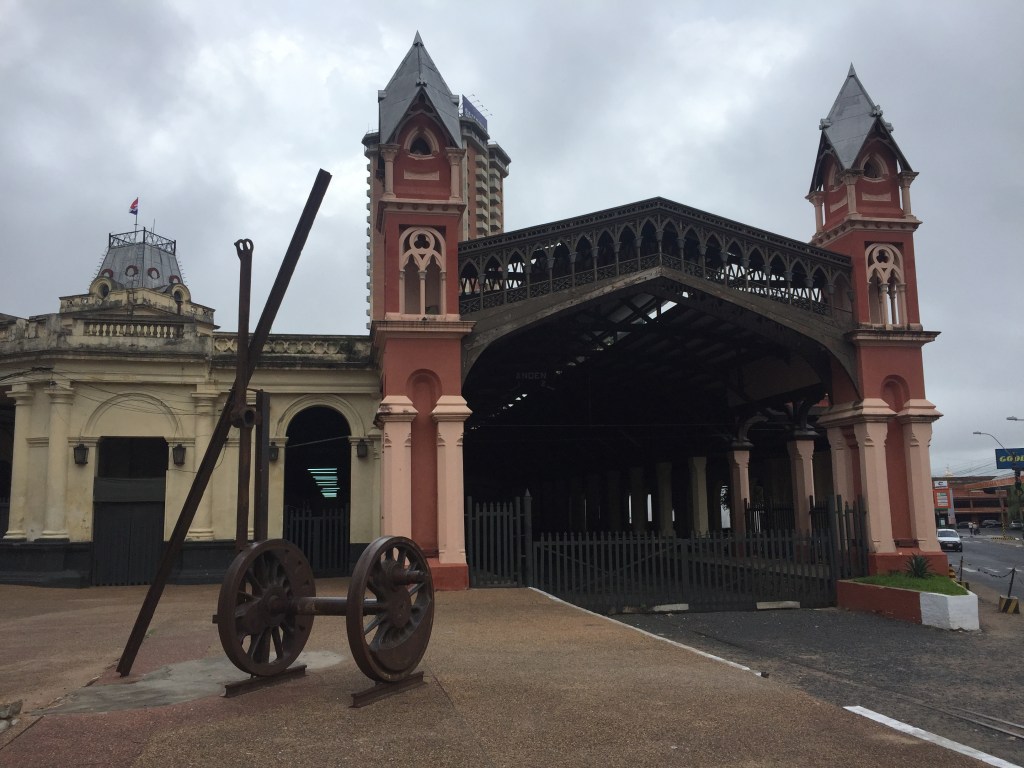
There is what can loosely describe as a museum, plus an original train from 1861.
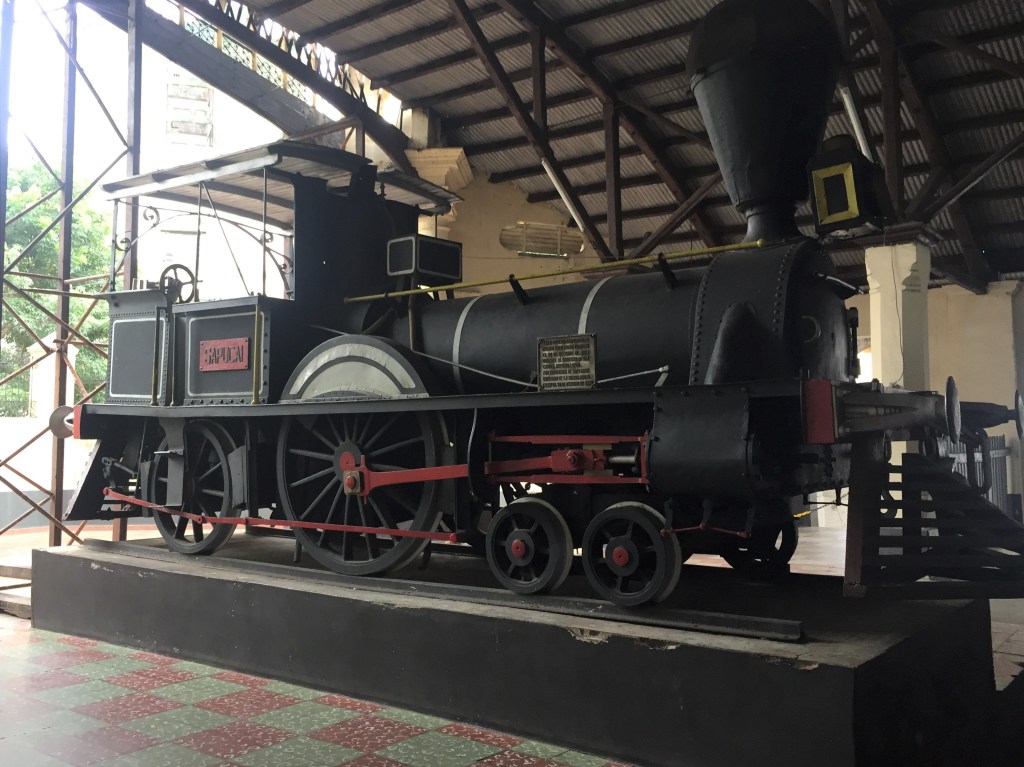
The station museum is open daily except Monday from 10 am until 5 pm. Entry costs 10,000 guaraní (around £1).
Plaza Uruguaya
The station is on the edge of the Plaza Uruguaya; a small park with some statues.

Catedral Metropolitana de Nuestra Señora de la Asunción
Next, we go to the 18th Century cathedral; the Catedral Metropolitana de Nuestra Señora de la Asunción, to give it its full title. The building is locked. Apparently, it is always locked unless there’s a religious service taking place. So we have to make do with looking at the outside of the cathedral.
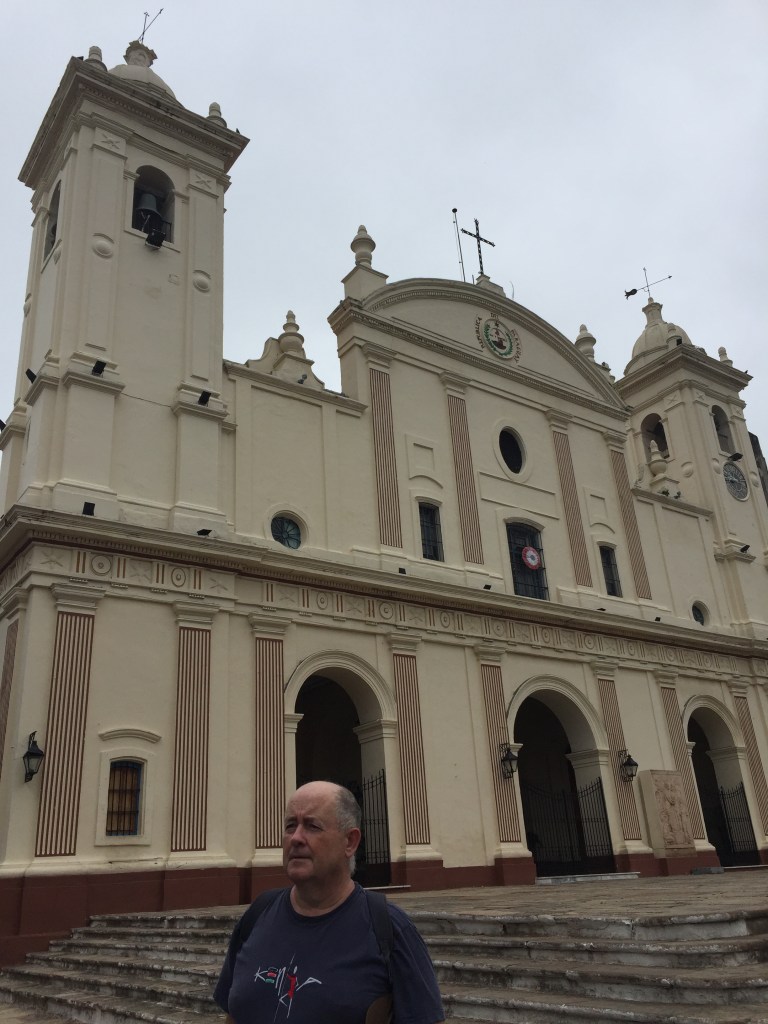
We set off instead for the waterfront (the Costanera), but the cathedral’s security guard tells us it is too dangerous and turns us back.
Cabildo
So we go to the next place of interest according to Lonely Planet, The Cabildo. The historic pink former town hall building dates back to 1844. It now houses a cultural Centre. To quote my guide book; “this influential cultural center is a meeting place for Bohemian thinkers.”

Plaza de Armas
Unfortunately, the entire Plaza de Armas, in front of the the Cabildo is a shanty town where hundreds of people (Comunidad Takuara’i) are living under tarpaulins. These indigenous people were evicted from their land by soy producers and have been camping in the central square for months demanding a solution to their plight. In the meantime, the Cabildo is closed.
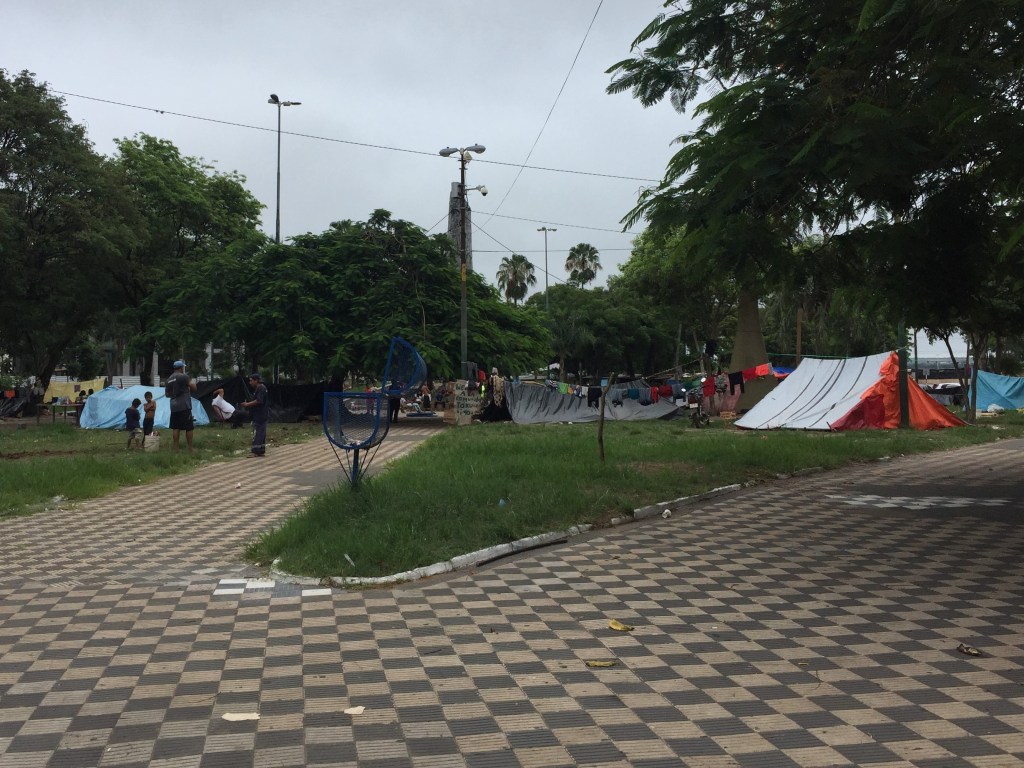
There is a lot of police. And guns. And shouting. And general unrest. As we can’t go into the Cabildo, I manage to find an angle to photograph the pink exterior and we move on.
Casa de la Independencia
We head briefly to the Casa de la Independencia which was built in 1772. It is here that Paraguay declared independence from Spain in 1811. It now houses a museum. However, today it is the scene of yet more unrest. The Casa is also closed, while a very drunk man argues with the police at the entrance.
Normally, open hours are Monday to Friday from 7.30 am until 4 pm and Saturday from 8 am until 9 pm. Entry is free.
Panteón de los Héroes
I decide I’ve had enough and return to the hotel, via the Panteón de los Héroes; a building where the remains of prominent Paraguayans are kept under ceremonial guard.
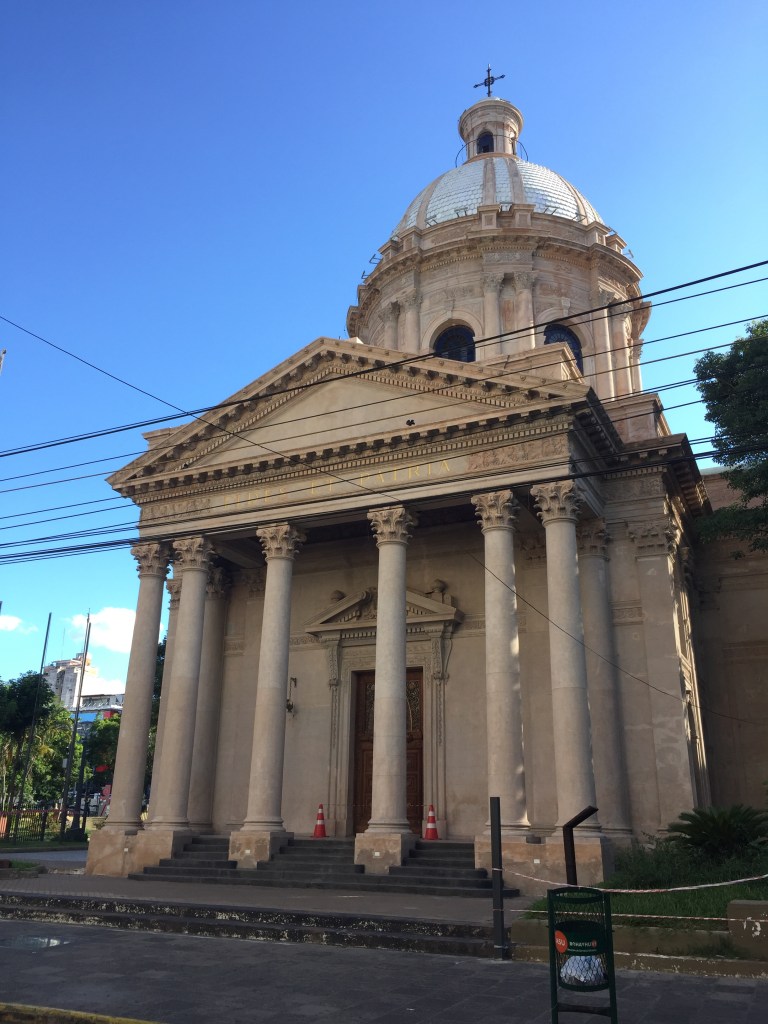
The Panteón is open daily except Monday from 7 am until 5 pm. Entry is free.
Costanera
In the afternoon, the old man braves a walk along the Costanera, the coastal promenade which runs along the River Paraguay, despite being told by the security guard not to go there. I retire to the hotel rooftop for a swim and a beer. I can see enough of the River Paraguay from up there…
Paseo de las Turistas
Along the Costanera are some monuments and the Paseo de las Turistas with the obligatory photo op sign. The old man returns unscathed, although he was approached by a man with a taser who was either trying to mug him or sell him a taser – he’s not quite sure which!

Dinner at El Bolsi
For dinner, we go to El Bolsi and I order lomito a caballo, which I think means loin cowboy style. I check with the waiter and he says it comes with eggs and onions. Not until it arrives and the meat seems rather tough, do I begin to wonder if I’ve actually ordered horse? But the starters were good!

That concludes our (thankfully short) time in Asunción. My guide book described Paraguay as ‘off the beaten track‘ and I can see why it’s not a popular tourist destination; it has little tourist infrastructure, it’s hot and dirty and dangerous enough for most shops and restaurants (and any other building really) to have armed guards. Not one of my favourite destinations.
- Trip taken: January 2019
- Updated: September 2025
I hope you found the above information useful. For guides to more destinations in the 50+ countries we have visited, check out my full list of Independent Travel Itineraries here.
 Jane's Midlife Journey
Leave a comment