
Today, we travel 125 miles west from Kyoto to Okayama. Technically, this can be done on the bullet train in under an hour. However, along the route lies one of Japan’s top tourist attractions; Himeji Castle. So, we will be taking two trains and stopping en route to explore Himeji and its famous castle.
Okayama in 1 Day Itinerary
| Himeji | Train to Himeji Himeji Himeji Castle Kokoen Garden Lunch at Darbar |
| Okayama | Train to Okayama Accommodation – Hotel Granvia Okayama Okayama Picnic by the Asahi River Okayama Castle Korakuen Garden |
Train to Himeji
We head to Kyoto Station for our first bullet train of the day to Himeji. Half an hour early due the old man needing to factor in contingency (we only had to walk across the street).

Himeji
Himeji Station is about a mile from its namesake castle. This is a straightforward walk up Otemae Street or one stop on Shinki Bus No 6. First, we must find a locker to leave our luggage for a few hours. It’s a tight fit, but we manage to squeeze everything in and set off sightseeing unencumbered.
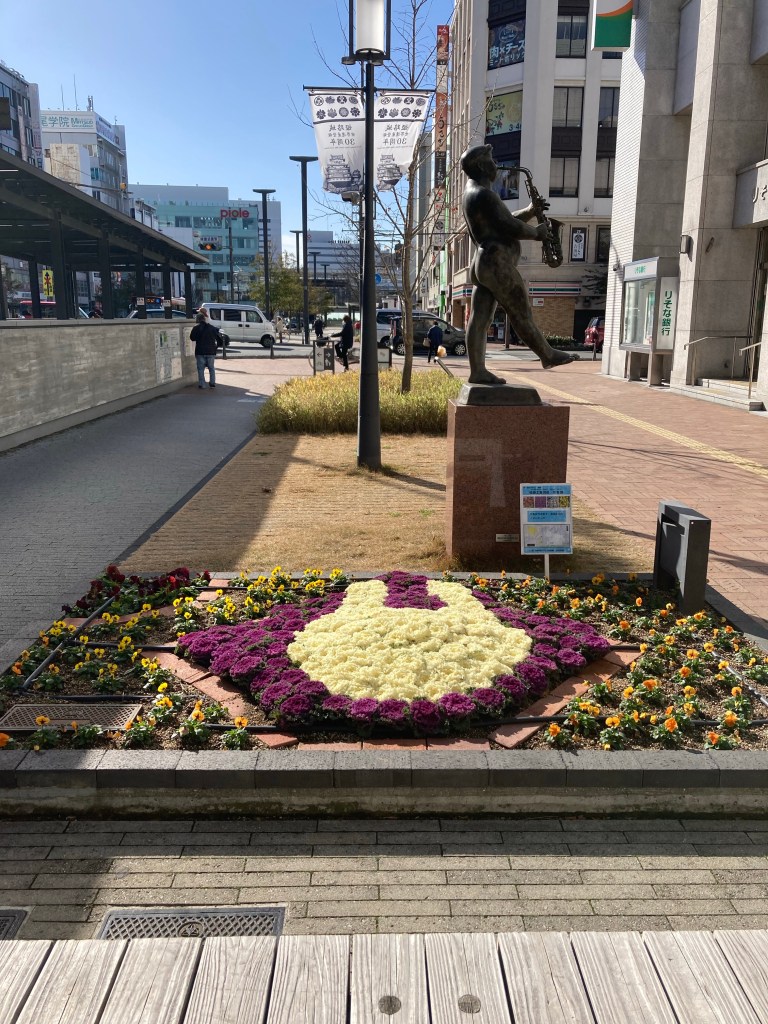
According to my guide book, free bicycles are available outside the station, so I suggest cycling to the castle. The old man is having none of this deviation from our normal routine, so we walk the mile to the castle. To be honest, it’s a pleasant walk along a wide boulevard lined with statues and floral displays (mainly cabbages). Even the drain covers are pretty.

Himeji Castle
Himeji Castle is Japan’s biggest and best preserved castle. Unlike many of the castles we have visited, which claim to be historic, but were actually reconstructed fairly recently, Himeji is original. Having said that, it did undergo an extensive renovation, which involved totally dismantling it and rebuilding it from scratch like an enormous 3D jigsaw puzzle.
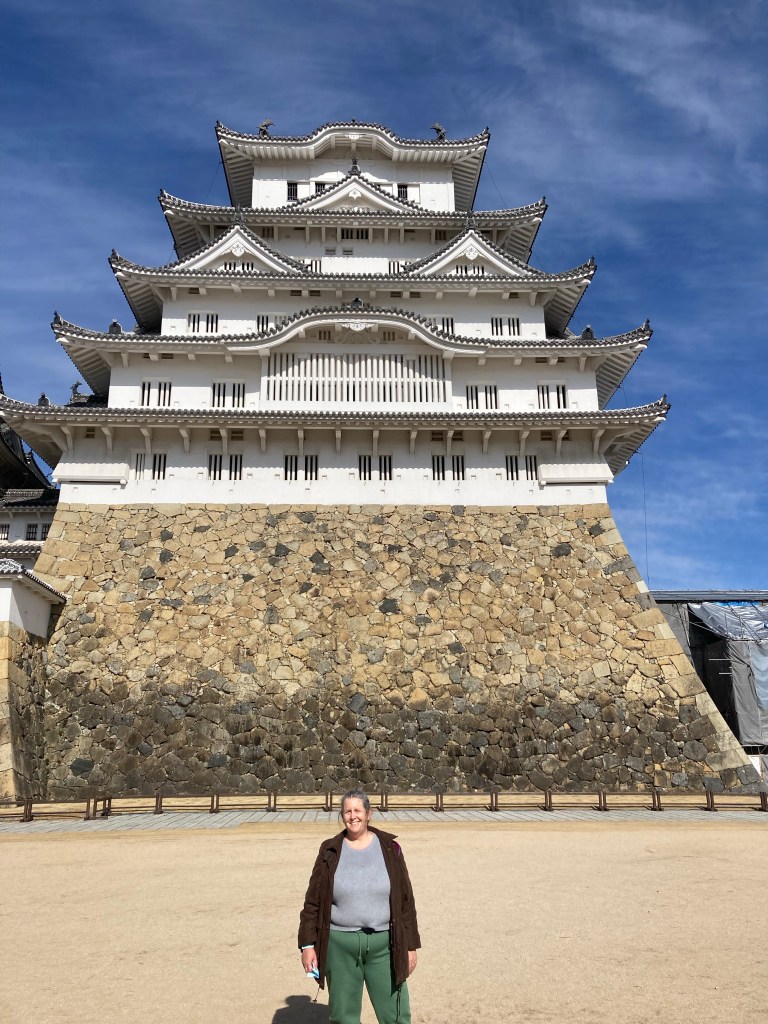
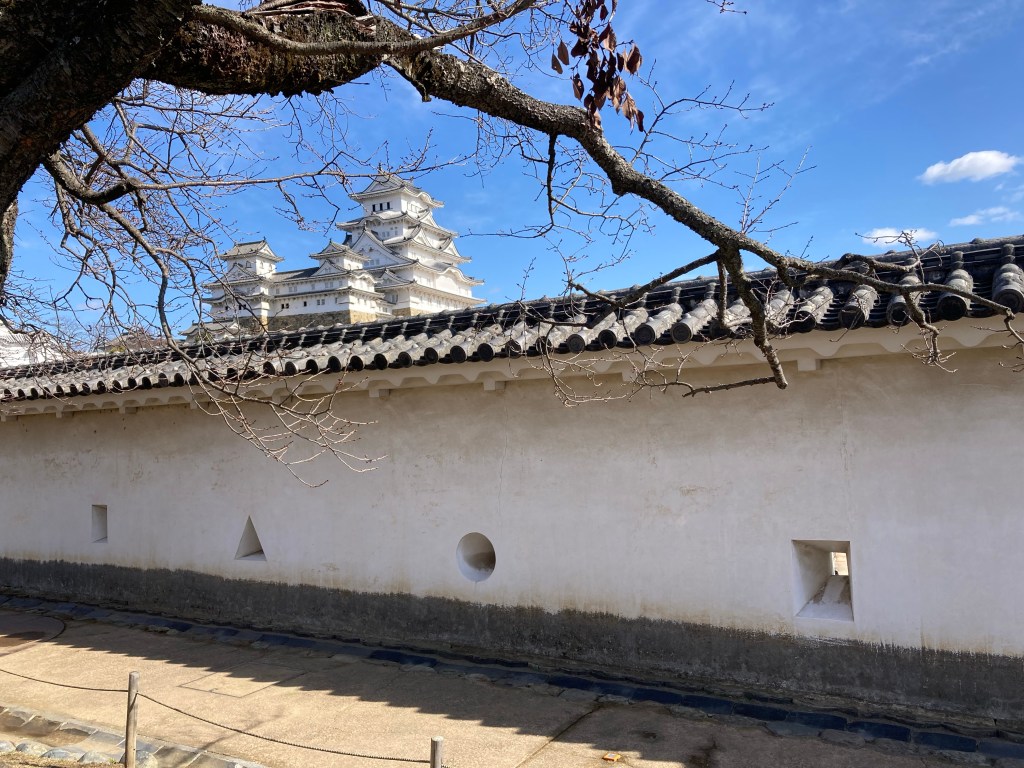
The building consists of a six storey main keep plus several smaller keeps, all surrounded by a maze of moats and walls deliberately contrived to confuse would-be attackers. The castle is nicknamed White Heron Castle as it is said to resemble a white bird in flight. As much as a castle can resemble a bird. Maybe after a couple of sakes?

There is a prescribed route to take around the castle and its grounds. This route takes you up to the top of the castle, back down (obviously), then in a loop round the castle grounds.
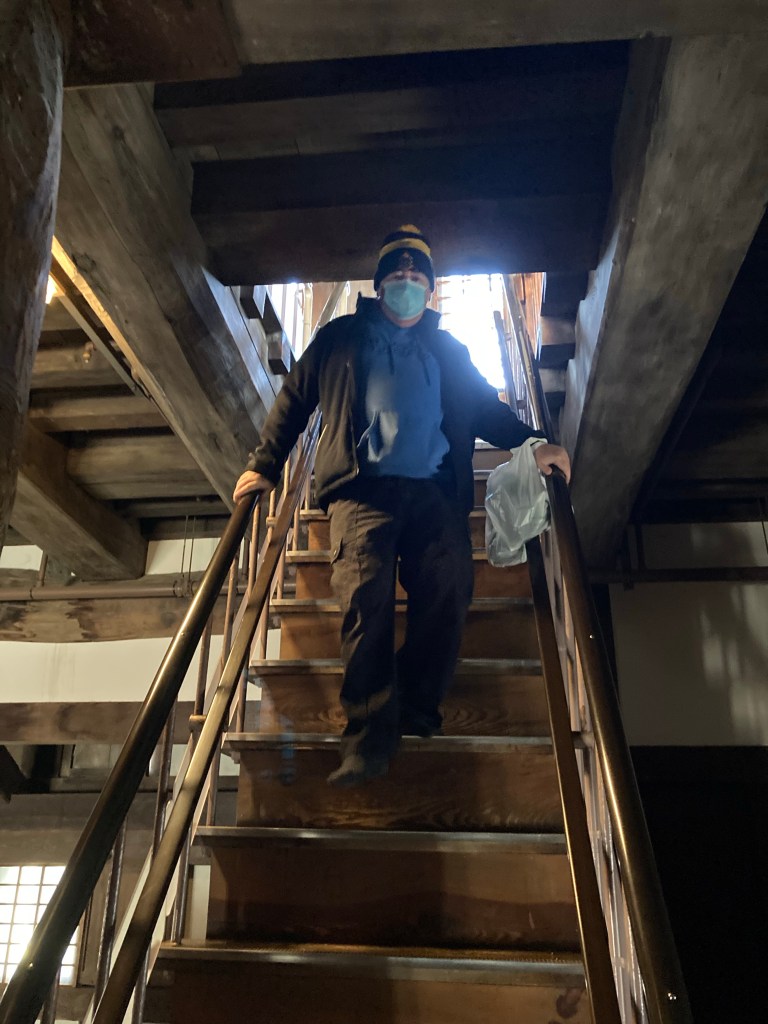
Upon entering the castle, you must remove your shoes and place them in a plastic bag. Inside it’s very dark. In the semi darkness, you must climb five flights of extremely steep, slippery wooden stairs in your socks whilst carrying your shoes (and when we visited, also wearing a mask). Quite a feat!
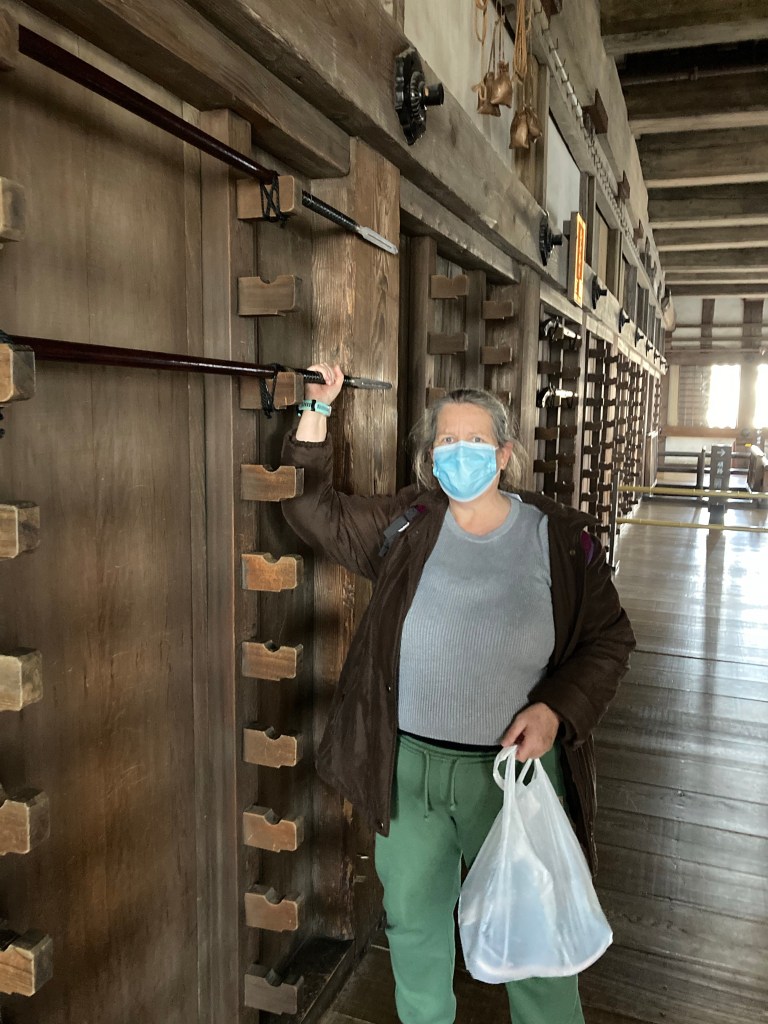
On each floor of the castle, there are informative boards telling the castle’s history, with displays of samurai armour, weapons etc. For example, we learned that the loopholes in the castle walls are square, round, triangular and rectangular to accommodate a range of weapons from arrows to stones to guns to oil.

From the top, there are great views across the castle grounds, the city of Himeji and beyond.

Then, we must descend the slippery wooden stairs. At one point, I get stuck when my shoe bag lodges in the bannister causing a pile up on the stairs. The old man has the added complication of trying not to knock himself out on the low ceilings.
The castle is open from 9 am until 6 pm (5 pm in winter). Adult entry to the castle costs Y2500 (around £11.70). Or you can pay Y2600 for a combined ticket to visit Kokoen Garden as well.
Kokoen Garden
After a wander round the castle grounds, we continue to Kokoen Garden; a reconstruction of a Samurai home, surrounded by nine themed gardens:
- Garden of the Lord’s Residence
- Garden of Seedlings
- Tea Ceremony Garden
- Flatly Landscaped Garden
- Garden of Summer Trees
- Garden of Pine Trees
- Garden of Flowers
- Garden with a Hill and Pond
- Garden of Bamboo
We visited in winter, which was not that exciting. Apart from the obvious lack of foliage, some of the gardens are closed, while in others, trees are covered in bright blue sheets.

We start in the Garden the Lord’s Residence. The focal point of which is a pond containing hundreds of carp, which an elderly Japanese woman is trying to attack with her walking stick.

We follow the prescribed route round the remaining gardens which are open. Kokoen is open daily from 9 am until 5 pm. If you haven’t purchased a combined ticket, adult entry costs Y400.
Lunch at Darbar
From Kokoen, we walk back towards the station to catch our train to Okayama. As we are walking , we smell the enticing aroma of curry. We decide to stop at the source of said aroma, Darbar Nepalese restaurant, for lunch. They serve a very reasonably priced daily set lunch. Today, it’s chicken and mushroom curry, rice, salad and a naan. The food is very tasty and the naan is absolutely massive. It comes served on a tray, hanging over both sides.

Train to Okayama
After our enormous lunch, we waddle the rest of the way back to the station for our train to Okayama. The 50 mile trip is a mere 19 minutes on the bullet train. We are spending the night in Okayama primarily because we have to change trains here and it seemed like the obvious place to break the journey. However, it does have a couple of interesting sites; Okayama Castle and Korakuen Garden and
Accommodation – Hotel Granvia Okayama
First, we check into tonight’s accommodation: Hotel Granvia Okayama, which describes itself as conveniently connected to the station. Albeit a Japanese station, so its still a 15 minute walk from the platform to the hotel foyer. Conveniently, this walk can be done through a shopping mall, so we pick up some supplies for dinner en route.
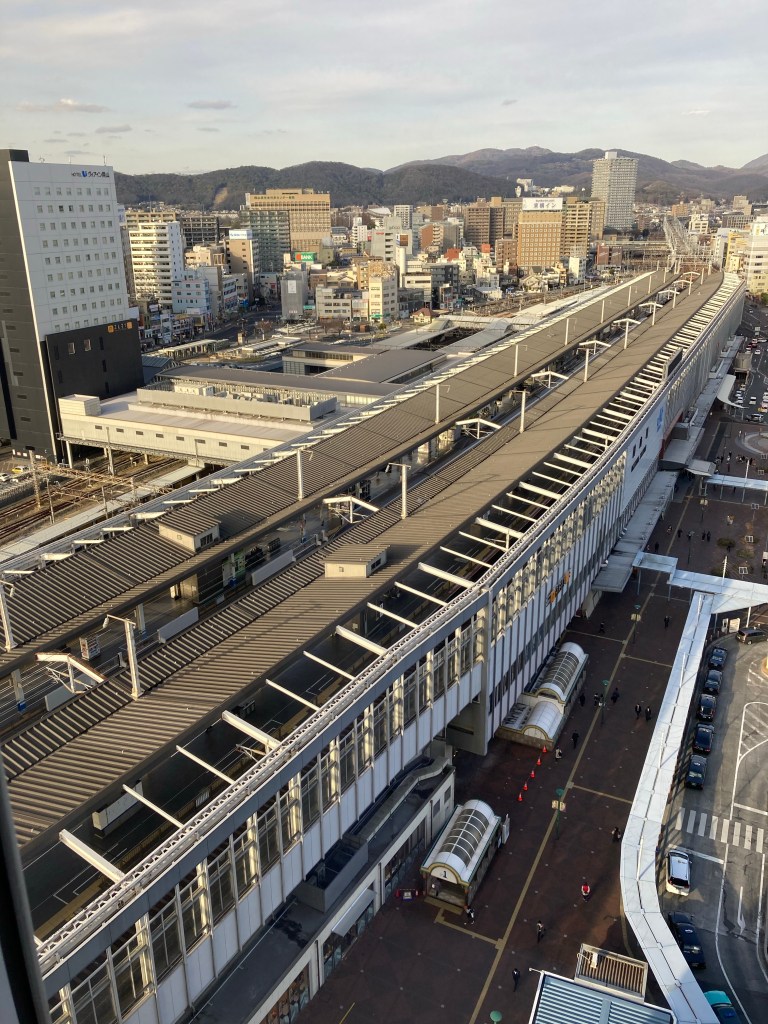
At check in, we are given an upgrade from the 17 m2 room we paid for to a 32 m2 room. It’s such a relief to have some space and not be constantly tripping over stuff/each other. At check in, we are also given some sachets. I’m not sure what it is. Sweets? Bath salts? Crack cocaine? I decide to throw it in the bath and take a soak (turns out it’s white peach and cypress bath salts).

Okayama
Then, it’s time to set forth and explore Okayama.

We start with a walk to the park. It’s quite a long walk and there’s a tram which follows the same route, but the old man is determined to walk (the tram costs 64 pence). Similar to Himeji, it’s another walk along a statue lined boulevard. This time no cabbages, just dozens of kamikaze cyclists.
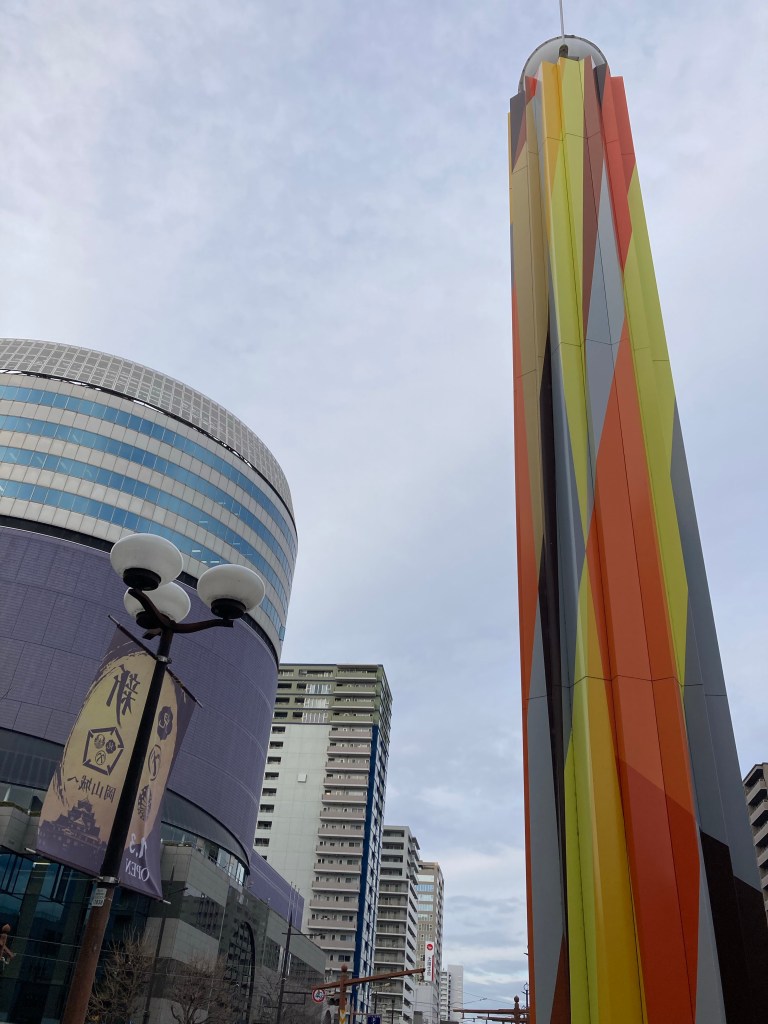
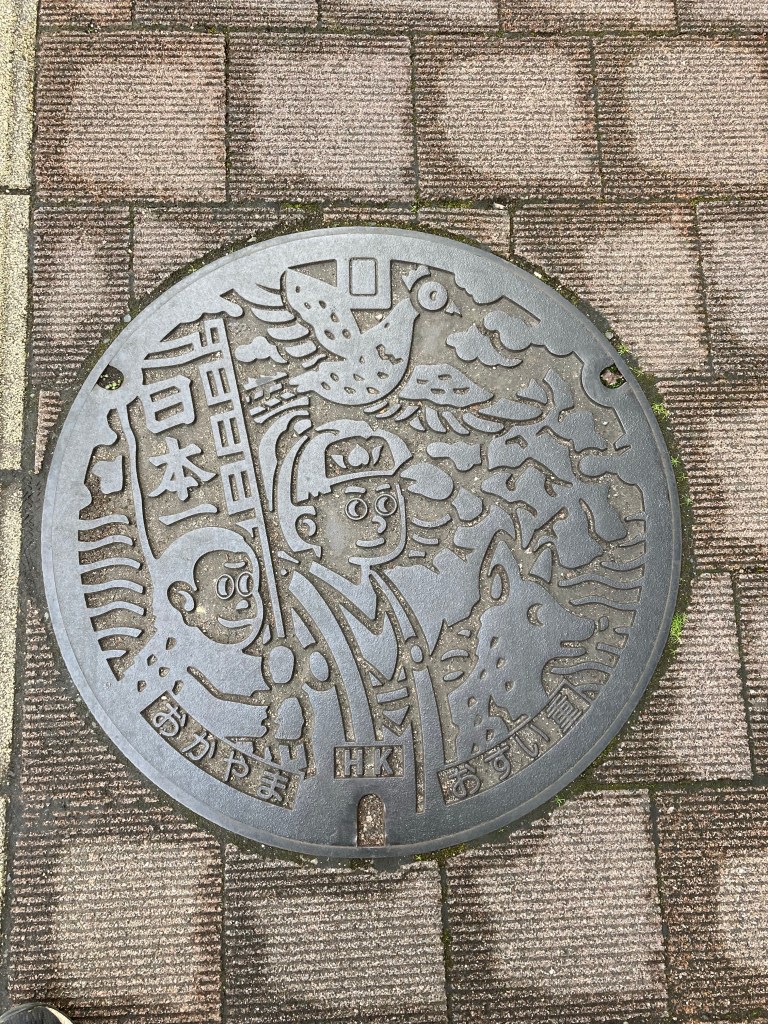
Every Japanese city seems to have a theme. Okayama’s is Peach Boy. According to the story, a childless couple found a baby in a peach. When he was older, the boy went off to fight ogres, befriending a talking dog and a monkey along the way. Hence, in Okayama even the drain covers have a boy, a dog and a monkey on them. There are also plenty of ogres. Ogres tend to be ginger.
Picnic by the Asahi River
We stop for a picnic on a bench overlooking the Asahi River and Okayama Castle.

Okayama Castle
Then, we continue to Okayama Castle. It is nicknamed Crow Castle because it’s black and the Japanese have a thing about naming castles after birds. Although there was a castle here in the 16th Century, this particular building dates from 1966. As this makes the castle the same age as me, the old man declares it is indeed ancient.
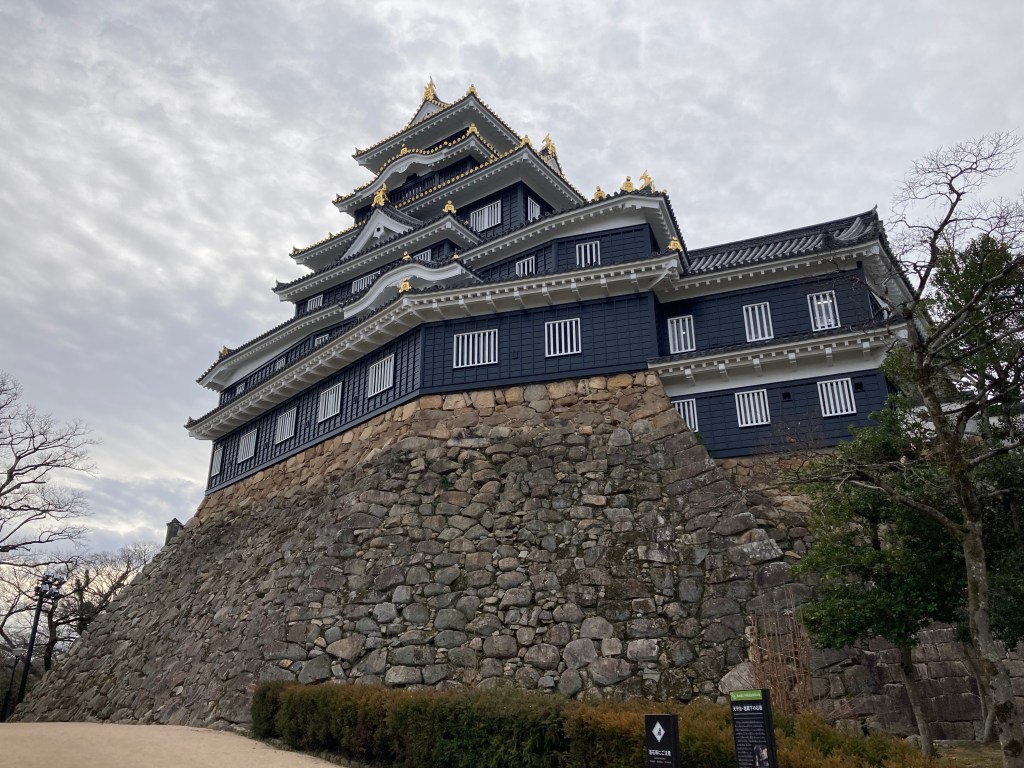
It may not be historic, however from the outside, the striking black building decorated with golden fish is pretty impressive.

The interior is rather modern, although there is an impressive collection of Samurai weapons and armour.

The castle is open daily from 9 am until 5.30 pm. Entry costs Y500 (around £2.30). Or you can buy a combined ticket for the castle and garden for Y800.
Korakuen Garden
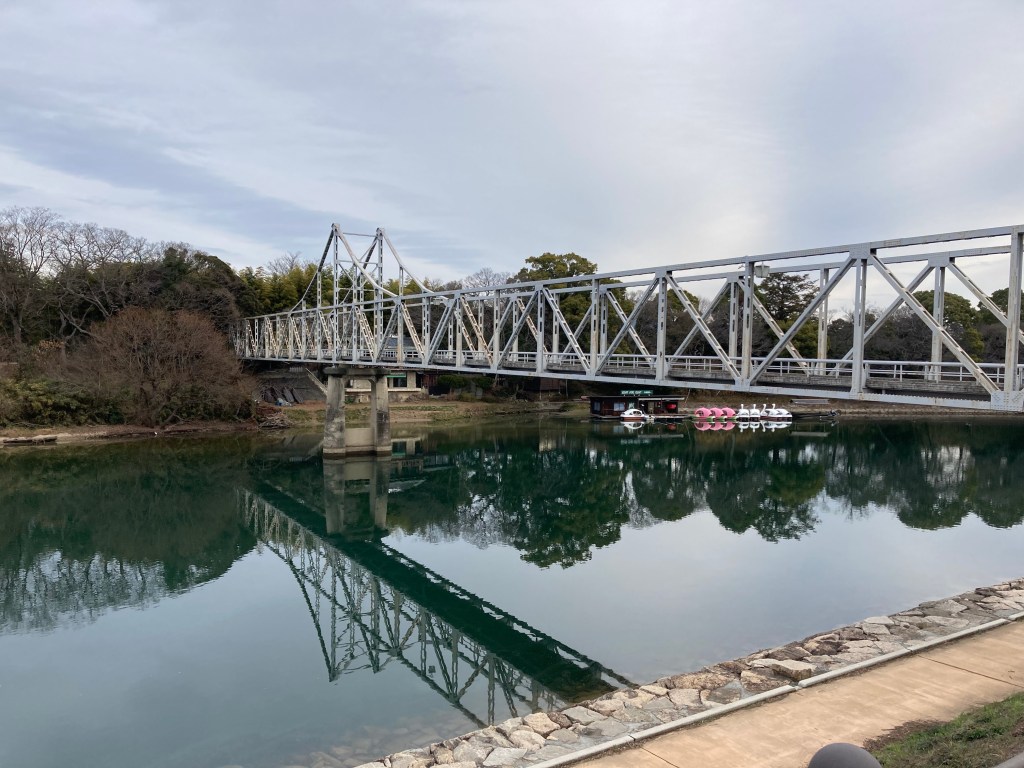
From the castle, we cross a footbridge over the Asahi River which brings us the the garden of Korakuen. Korakuen Garden is one of the Three Great Gardens of Japan. This is partly due to the garden’s proliferation of cherry and maple trees, which look spectacular in spring/autumn. However, so much of the focus in this garden is on the rocks, water features, bridges, tea houses and other buildings, that it’s picturesque even in January.

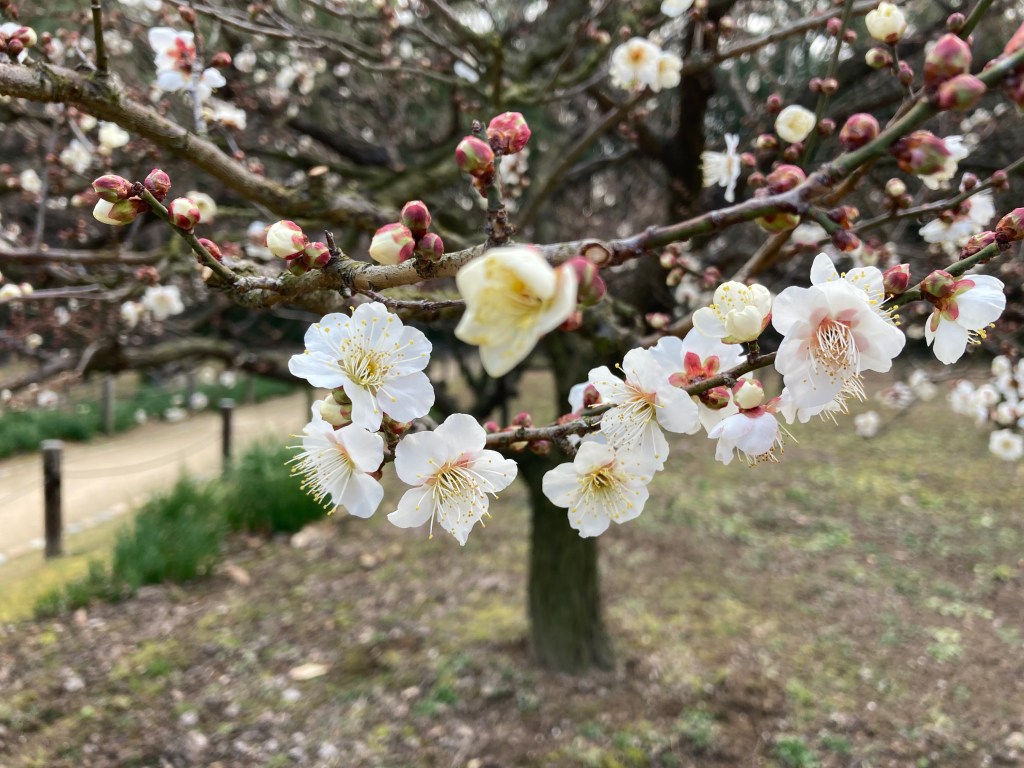
In fact, the Japanese winter has been so mild that there are actually some cherry trees starting to blossom in mid January.
The garden is open daily from 7.30 am until 6 pm (5 pm in winter), later at weekends. If you don’t purchase a combined ticket, adult entry costs Y500.

The old man determines that we should walk back to the hotel. Today has entailed quite a lot of walking. As we walk, I count the number of trams that pass by full of people with non-achy feet.
- Trip taken: January 2023
- Updated: April 2026
I hope you found the above information useful. For guides to more destinations in the 50+ countries we have visited, check out my full list of Independent Travel Itineraries here.


 Jane's Midlife Journey
Leave a reply to Jane’s Midlife Journey Cancel reply