

Sofia is an ideal place for a weekend break. We travelled to Sofia for a long weekend, spending two days in the Bulgarian capital and a third day on a tour to the stunning Rila Monastery. The Monastery, a UNESCO World Heritage Site, is around 70 miles south of Sofia. It is quite spectacular, so I thoroughly recommend making room in your itinerary to go and see it.
How to get to Sofia
We flew to Sofia Vasil Levski Airport, which is around 6 miles east of Sofia. From here, it is a 30 minute trip into the city on the Metro (Line M4). Tickets cost 2 Lev (about £0.90).
Getting Around Sofia
Most of Sofia’s attractions are close enough together to be visited on foot. To reach those which are further out of town, we took the Metro, which is clean, efficient and cheap.
Where to stay in Sofia
We stayed at the Arena di Serdica Boutique Hotel. This isn’t where we booked; we had a reservation at another hotel further out of town with a pool. But when we arrived, our intended hotel had a problem and moved us. The Arena di Serdica is a very nice, conveniently centrally located hotel. It doesn’t have a pool. Apparently there was one in the plans, but when builders started digging the hotel’s foundations, they discovered Roman remains, which have been excavated and incorporated into the hotel’s design.

Sofia in 2 Days Itinerary
| Day 1 | Flight to Sofia Accommodation – Arena di Serdica Boutique Hotel Sveti Nikolai Russian Church Presidency Aleksander Nevski Cathedral St George Rotunda Church Dinner at Happy Bar and Grill |
| Day 2 | Museum of Art from the Socialist Period Borisova Gradina Saint Sofia Monument Central Department Store Vitosha Boulevard National Palace of Culture Dinner at Hadjidraganovite Kashti |
Sofia Day 1
Flight to Sofia
The flight to Sofia is uneventful. We head for the Metro station and after a few issues with the ticket machine, head into town for our hotel. It’s very hot and we manage to exit the Metro at the wrong exit and head in the wrong direction (twice). By the time we eventually reach the hotel, we are very sweaty; the pool is sounding all the more inviting. At reception, we are informed that there has been a burst pipe and an entire floor (ours) is out of bounds. So we are sent by taxi to a sister hotel.

Accommodation – Arena di Serdica Boutique Hotel
We end up at the Arena di Serdica Boutique Hotel. It’s quite unique staying in a hotel with its own Roman ruins. And it is also a very nice hotel. Another bonus is that it is far more central than the one we had booked. But I am still disappointed by the lack of a pool.

Sveti Nikolai Russian Church
After refreshments in a nearby bar (no pool, so we have to make do with a beer to cool us down), we set forth for some sightseeing. First, the Sveti Nikolai Russian Church, set in pretty gardens, with its glistening golden onion domes. The church dates back to 1907, when it was built by the Russian Embassy for the Russian community in Sofia.

Presidency
Next up, the Presidency. Architecturally, there’s not much to see at the President‘s Building; security is tight and you can’t get particularly close. But it’s definitely worth coming here on the hour to see the Changing of the Guard. It’s like military theatre.

If you want the full pomp and ceremony, there is a full military Changing of the Guard ceremony, complete with music, shouting and weapon brandishing, on the first Wednesday of the month at midday.
Aleksander Nevski Cathedral
The number one tourist destination in Sofia is the iconic Aleksander Nevski Cathedral. This enormous 19th century cathedral is synonymous with the city of Sofia and is quite a sight on a sunny day, with the light reflecting off its many domes. The church was built between 1882 and 1912 in a neo-Byzantine style, to remember the 200,000 Russian soldiers who died fighting for Bulgarian independence during the Russo-Turkish War.

If there isn’t a service in progress, you can visit the equally impressive interior, adorned with frescoes and plenty of gold.
St George Rotunda Church
One last church; Saint George Rotunda Church. Built way back in the 4th Century as a Roman Bath, this tiny church is Sofia’s oldest preserved building.

Dinner at Happy Bar and Grill
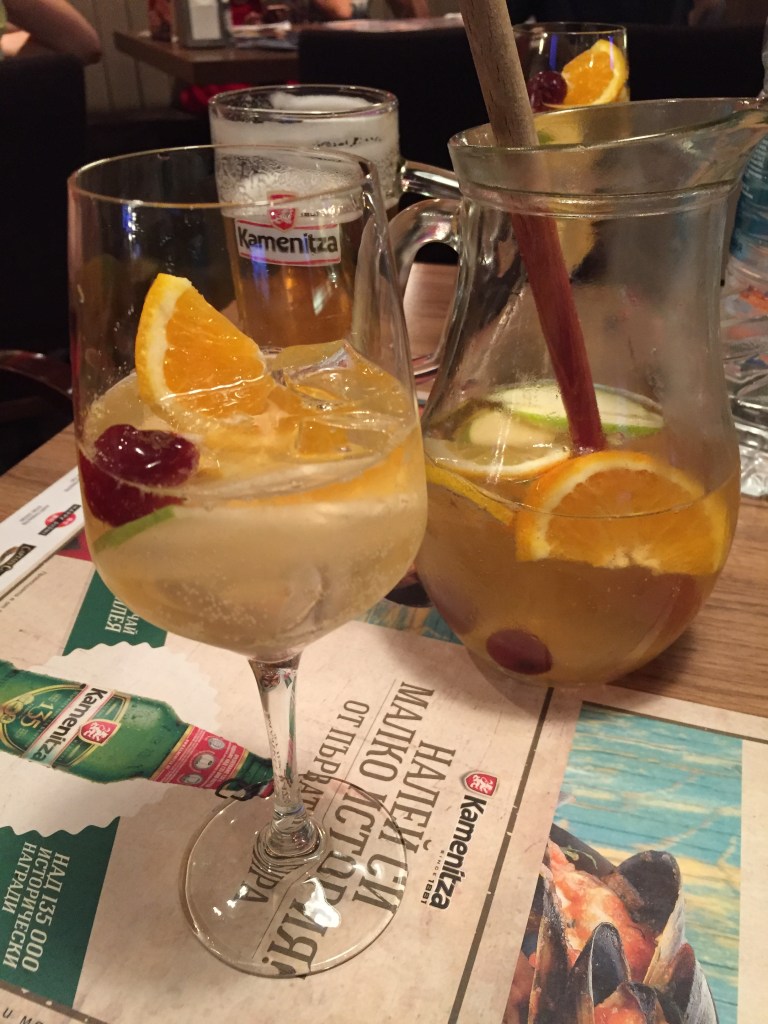
We usually try to and eat authentic local cuisine on our travels, but it’s been a long, hot day so we just plonk ourselves down at the nearest eatery and end up drinking sangria and eating chips at the Happy Bar and Grill.
Sofia Day 2
Museum of Art from the Socialist Period
Many years ago, I studied East European Studies at university and love a bit of socialist realist art. So this morning entails a metro ride out to the suburbs and the fascinating Museum of Art from the Socialist Period.

The M4 or M1 Metro Lines to G.M. Dimitrov get you to within a 10 minute walk of the museum. It’s not the easiest place to find. However, in amongst a collection of modern office buildings, we finally spot an enormous red star (that once stood atop the former Party House in the centre of Sofia) which indicates that we have located the museum.

After the fall of communism in Bulgaria, officials wondered what to do with the various sculptures and art work which depicted communist ideals which were in evidence across the city. The answer was to take them all down and dump them in a garden on the edge of town; now the Museum of Art from the Socialist Period.

Here, you can wander round the garden full of Lenin busts, red stars and all manner of other sculptures. There’s also an art gallery. This is my idea of the perfect way to spend a morning.

The Museum is open from Tuesday to Sunday between 10 am and 6 pm. Entry costs 8 lev (around £3.40) or 3 lev on Thursdays.
Borisova Gradina
We return to the Metro and head a couple of stops back towards town, alighting at Vasil Levski Stadium for the next on the list on this morning’s socialist public art extravaganza. This one is is located in the Borisova Gradina; a large area of parkland, with plenty of gardens and statues as well as various cafes and bars for refreshments along the way.

The Mound of Brotherhood
Our ultimate goal isn’t signposted, or maintained, but we finally find it behind the trees covered in graffiti; The Mound of Brotherhood.

The mound is home to a 42 metre high socialist realist obelisk flanked by working class heroes and gun toting communists.
Saint Sofia Monument
We catch the Metro back to Serdika for our next stop; the Saint Sofia Monument, which can be found in the middle of a traffic island. This statue of Saint Sofia, after whom the city is named, sits atop a 24 metre column. She replaces the previous occupant; Lenin. It’s quite difficult to photograph the statue as (1) it’s very sunny and (2) I don’t want to get run over.

Central Department Store (TZUM)
Next, a quick detour to the Central Department Store. Usually abbreviated to TZUM, this ornate building, constructed in the 1950s, was communist Bulgaria’s flagship store. In its heyday it saw up to 120,000 visitors a day.

Vitosha Boulevard
Next, we take a wander along the kilometre long stretch of Vitosha Boulevard, lined with shops and street cafes, which leads towards the National Palace of Culture.

National Palace of Culture
The National Palace of Culture is another icon of the communist era. This octagonal (in my opinion) concrete monstrosity, built in the 1980s, houses a concert hall, conference centre and cafes. It is reached via a fountain lined park; Ploshtad Bulgaria.

Dinner at Hadjidraganovite Kashti
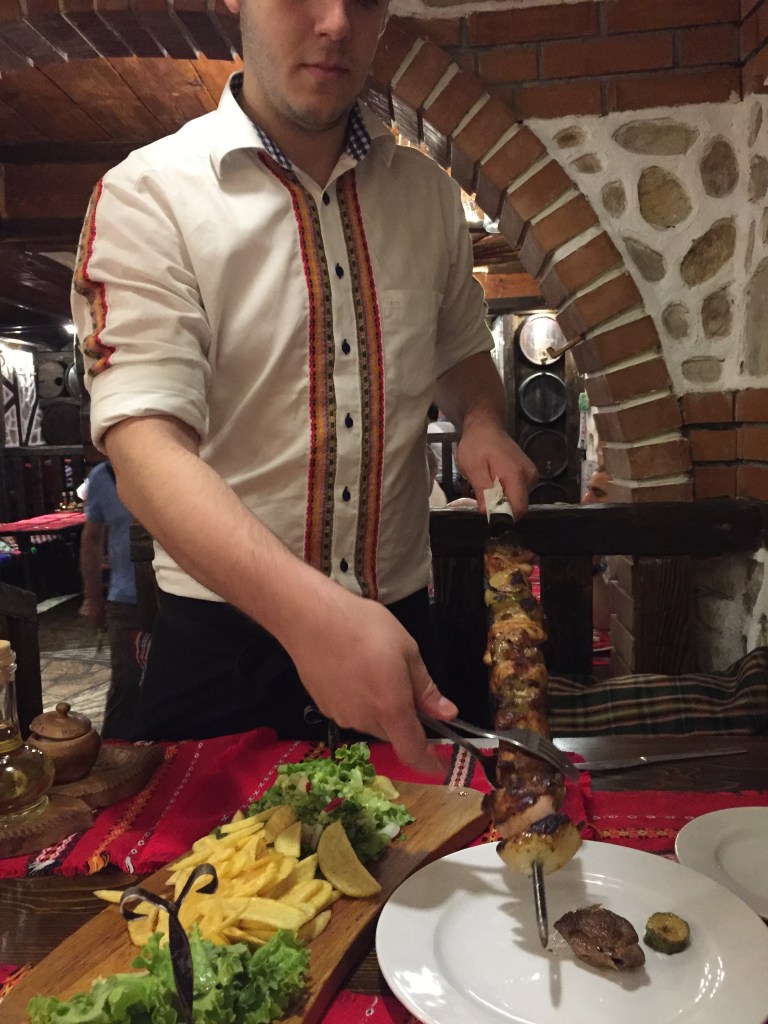
It’s been a long day with a lot of walking. Time to go in search of sustenance. We have chosen a restaurant offering Bulgarian food and entertainment; Hadjidraganovite kashti. It’s a bit kitsch, with wooden menus, staff in national dress and live folk music. But it is an entertaining evening. With very good food.
- Trip taken: June 2016
- Updated: February 2025
I hope you found the above information useful. For guides to more destinations in the 50+ countries we have visited, check out my full list of Independent Travel Itineraries here.


 Jane's Midlife Journey
Leave a comment