
The old man’s quest to become a parkrun alphabeteer (running a parkrun beginning with each letter of the alphabet) has brought us to Poland, via Germany, with a brief foray into Slovakia. We flew into Berlin and, after running parkrun in Dresden, crossed the border into Poland. We spent a week driving across Poland as part of our parkrun adventures. Our trip took in six cities, culminating in Zielona Góra for a Polish parkrun.
Poland 1 Week Road Trip Itinerary
| Day 1 | Dresden to Wrocław Wrocław Wrocław Town Square Wrocław Town Hall Dwarf Statues St Elizabeth’s Church Wrocław Univesity Dinner at Pasibus Accommodation: B&B Hotel Wrocław Centrum |
| Day 2 | Wrocław to the Tatra Mountains Auschwitz–Birkenau Auschwitz Birkenau The Tatra Mountains |
| Day 3 | The Tatra Mountains to Krakow Kraków Wawel Royal Castle Wawel Cathedral Rynek Główny (Main Square) Sukiennice (Cloth Hall) Rynek Underground St Mary’s Basilica Barbican Drinks at a Vodka Bar Dinner at Czarna Kaczka (the Black Duck) Accommodation: Rembrandt Aparthotel |
| Day 4 | Kraków to Warsaw Warsaw Palace of Culture and Science Warsaw Ghetto Wall Saxon Park Tomb of the Unknown Soldier Old Town Royal Castle St John’s Cathedral Dinner at Specjaly Regionalne Accommodation: Mamaison Residence Diana |
| Day 5 | Warsaw to Gdańsk Gdańsk European Solidarity Centre Gdańsk Old Town Żuraw Motława River Waterfront Mariacka Street St Mary’s Basilica Długi Targ Neptune’s Fountain Ice Cream from Grycan Accommodation: Hotel Number One by Grano Gdańsk |
| Day 6 | Gdańsk to Poznań Poznań Town Hall Poznań Cathedral Porta Posnania Heritage Centre Dinner at Stary Browar Accommodation: Hotel Stare Miasto Old Town |
| Day 7 | Poznań to Zielona Góra Zielona Góra Winny Park Palmiarnia Old Town Bacchus Statues Accommodation: Qubus Hotel Zielona Góra |
| Zielona Góra parkrun |
Poland Day 1 – Dresden to Wrocław
The drive from Dresden to Wrocław does not start well; I accidentally set the SatNav for Poznań, some 114 miles further north. Luckily, I realise before we’ve gone too far and after two rather complicated figure of 8 junctions, we are back on track. The old man is not impressed. Luckily, we stopped at Lidl on the way out of town, so I am able to placate him with a sausage croissant.
An hour later, we reach the Polish border. It’s not manned – we don’t even need to reduce speed, let alone stop. The only differences are that the road signs have changed languages and my phone picks up 4G.
Wrocław
We arrive at today’s destination; the city of Wrocław. This city on the banks of the Oder is know for its town square, its ancient university and its dwarves. Once we have parked up at our hotel, we set off explore the city.
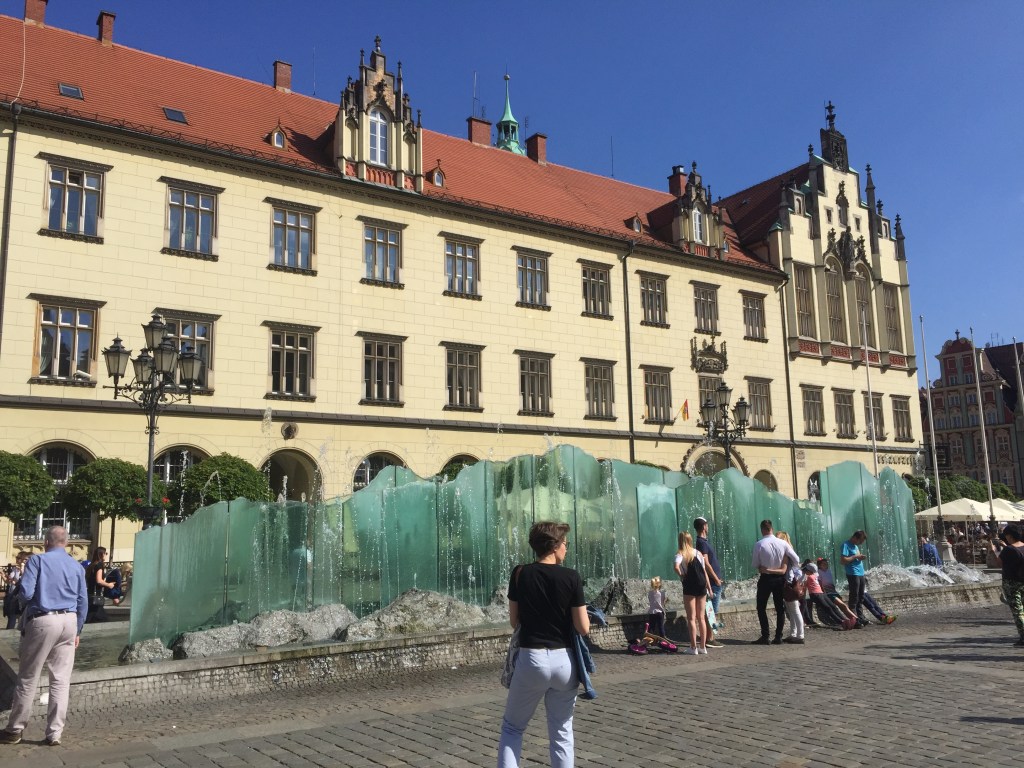
Wrocław Town Square
Wrocław Town Square is buzzing. In fact, arriving in Wrocław mid Saturday afternoon is a bit like coming late to a party, when everyone else is already drunk and you have to decide whether to drink lots in an attempt to catch up or not.
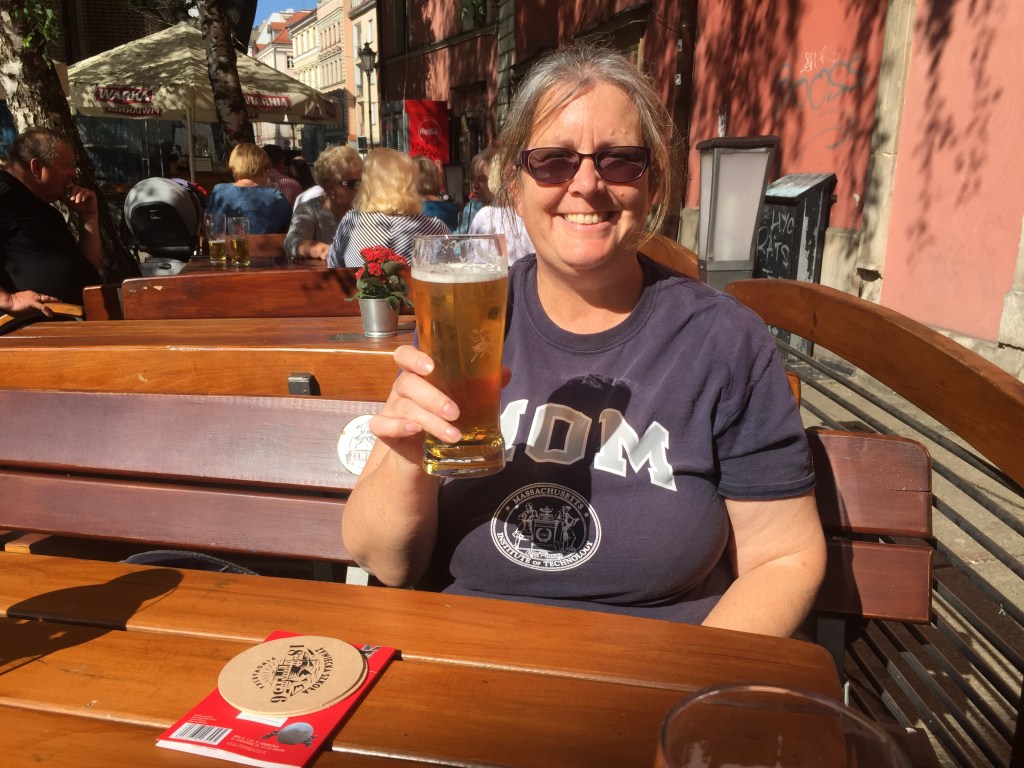
Cue a stop at a beer garden…
Wrocław Town Hall
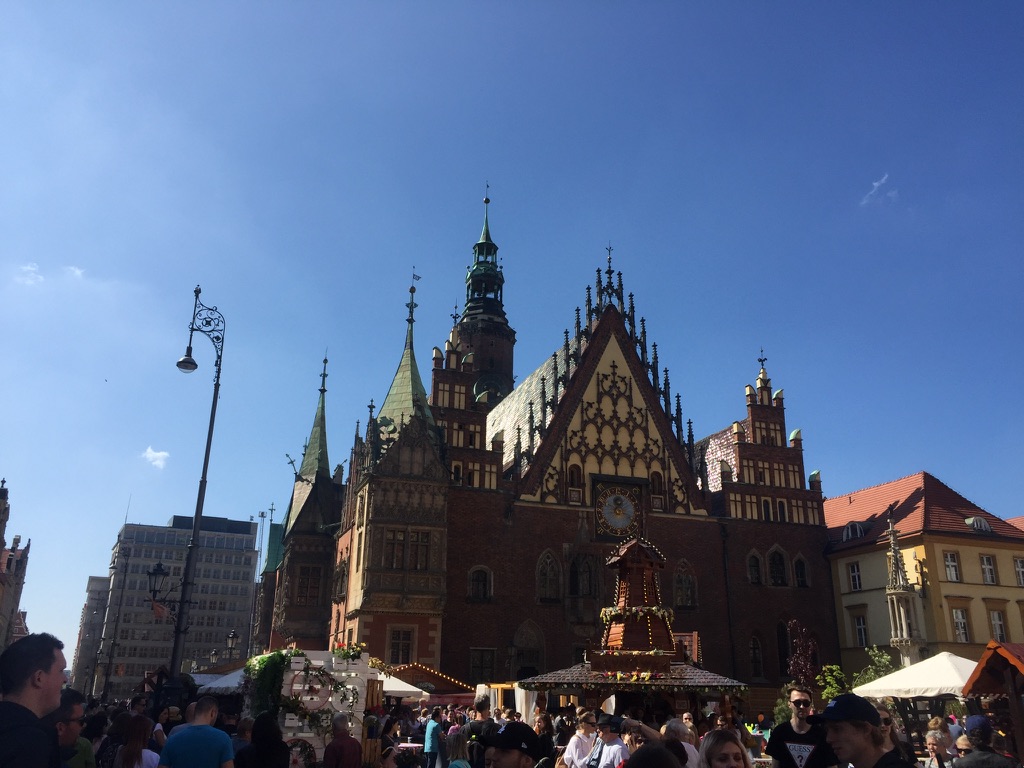
Overlooking the square is Wrocław Town Hall. This iconic building was constructed over hundreds of years with a 14th Century Gothic facade on one side and a 16th Century Renaissance facade on the other. It also house a wooden astronomical clock which dates from 1580.
Dwarf Statues
We take a wander round the old town looking for Dwarf Statues as we go. There are over 400 of these diminutive statues spread around the city – this could keep me amused for some time! The little statues are actually quite hard to spot, because they’re very small and the streets are mega crowded.
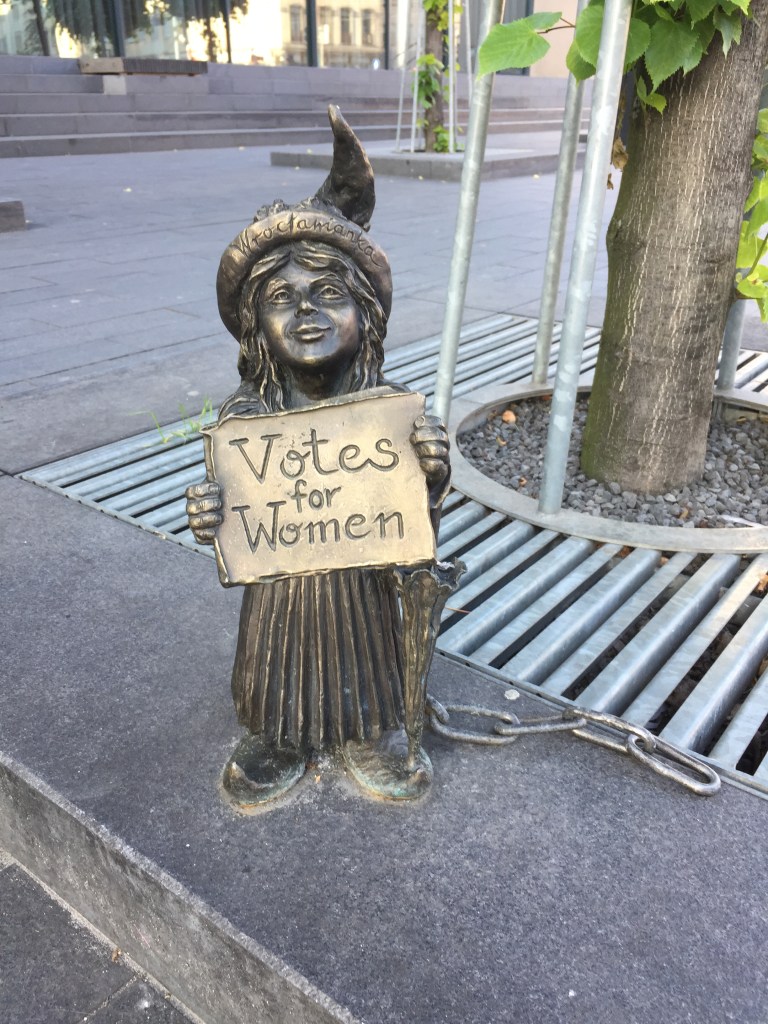
The dwarves were originally placed during Soviet occupation by the Orange Alternative, an underground protest movement that used absurdity to stage peaceful protests.
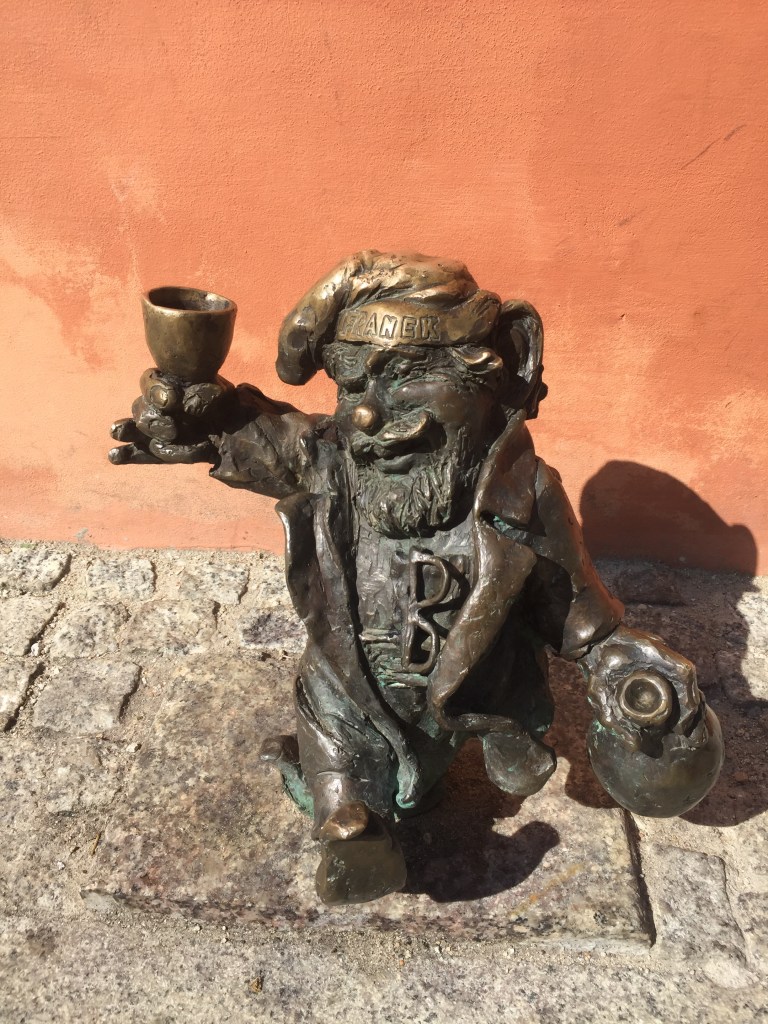
If you’re really interested in gnome spotting, you can purchase a map from the Tourist Information Office.
St Elizabeth’s Church
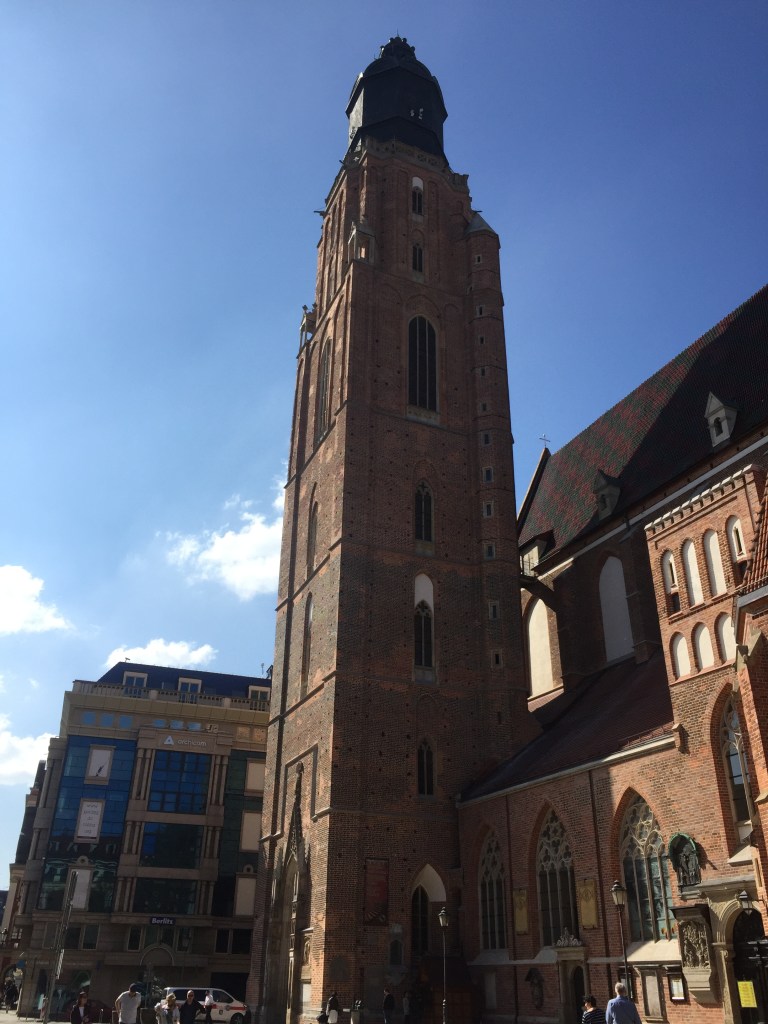
St Elizabeth’s Church dates back to the 14th Century, although it has been rebuilt several times due to damage by hail, war and fire. During the summer, you can climb to the top of the 91 metre tall tower for a stunning view of the city.
Wrocław University
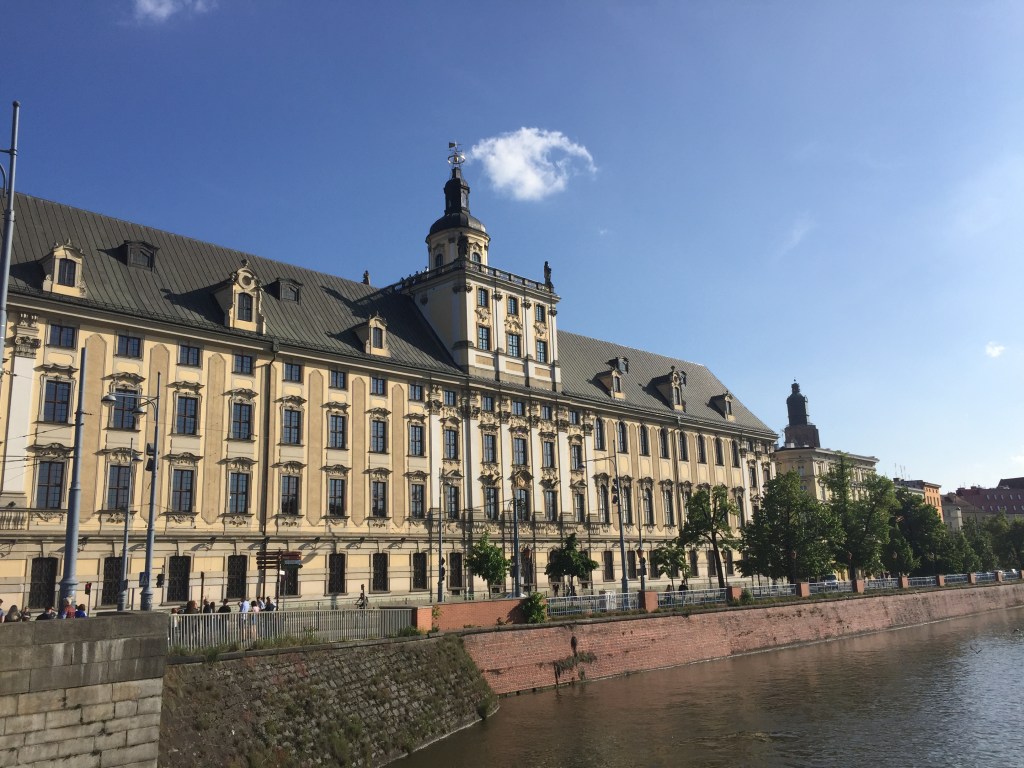
Overlooking the river is the grand 18th Century Wrocław University.
Dinner at Pasibus
After we are all dwarfed out, we stop at a burger joint called Pasibus, where I have a mango and chilli burger – an inspired combination!
Accommodation: B&B Hotel Wrocław Centrum
Our hotel for tonight is B&B Hotel Wrocław Centrum. The room in nice, but stinks of cigarettes. Two women are busy spraying it with a sickly air freshener which, frankly, makes it worse. The hotel is, however, conveniently located, just a 10 minute walk from the old town. It’s very much a budget hotel, but offers everything we wanted for an overnight stay; clean, comfortable rooms, free wifi and an on-site car park.
Poland Day 2 – Wrocław to the Tatra Mountains
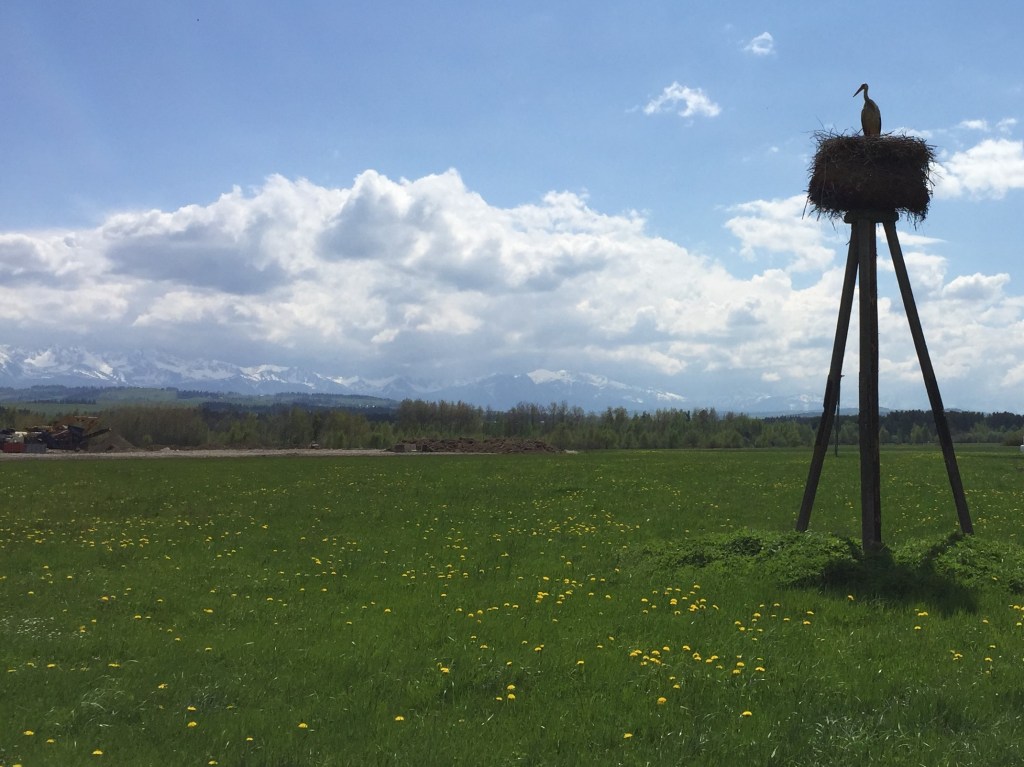
Today, we have a five hour drive through the Tatra Mountains to Ždiar in Slovakia, mainly so that the old man can check Slovakia off his list of countries visited. Even if you don’t go all the way to Slovakia, the Tatra Mountains are beautiful and well worth a visit. We stop en route in the town of Oświęcim to visit the Concentration Camps of Auschwitz–Birkenau.
Auschwitz-Birkenau
Ironically, these days, with around 2 million visitors a year, Auschwitz-Birkenau is quite difficult to get into. It is possible to visit at your own pace, however visitors are encouraged to join a guided tour. As a guideline, when we visited, individual visitors were only permitted entry before 10 am and the wait for a guided tour was 3 hours. So arriving early and/or booking in advance is recommended.
The camp opens to visitors daily at 7.30 am, with closing times varying according to the season. Further details here. Entry is free, but you have to pay to park, for a guided tour and to use the toilet.
We make the 10 am cut off time for individual visitors with minutes to spare, although it has meant skipping breakfast. It feels inappropriate to complain about being hungry in a place like Auschwitz. I fail to gain entry at the first attempt as I have left my passport in the car. Then there is an issue with the spelling of my name on the ticket. Finally, on the third attempt, I am admitted and we can pass through the iconic ‘Arbeit Macht Frei‘ gate.

Auschwitz
The original camp at Auschwitz consists of around 30 blocks, with most of the blocks now forming a museum detailing the history of Auschwitz. Some blocks cover the history of the camp in general. While others recount the plight of specific groups of prisoners. There are blocks given over to countries which represent the biggest numbers of prisoners here.

Permanent Exhibition
Blocks 4, 5, 6, 7 and 11 contain the Permanent Exhibition; this includes a series of rooms of items removed from prisoners; there are rooms full of shoes, spectacles, toys, suitcases, prosthetic limbs…

Most harrowing is the room full of hair. Upon arrival, women and girls had their heads shaved and the hair was used to stuff furniture. For some reason, to me, this room most graphically portrays the scale of the horror of the holocaust. I have been here once before and had nightmares about that hair for weeks afterwards. On the other side of the room is a chaise longue belonging to a Nazi officer’s wife, stuffed with the hair of murdered Jewish women and children.

The corridors are covered with the prisoners’ record cards. Corridor after corridor. Thousand upon thousand of them, each representing a person who died here. When you reach the end, there’s a notice explaining that from 1943, prisoner record-keeping stopped. These are just the first few thousand of the millions who perished here.
I try to work my way through the blocks but the number and size of tour groups is immense. I keep getting stuck in buildings and panicking, because I can’t get out. I can’t imagine how terrifying it must have been to be imprisoned here but I certainly wouldn’t have lasted long!
National Exhibitions
I move on to the National Exhibitions, which are less crowded. Block 14, the Russian Exhibition, is particularly interesting. The camp began in 1941 as a Prisoner of War camp housing mainly Russian soldiers. In 1945, it was the Red Army who liberated the remaining prisoners. This exhibition charts both the plight of the Russian PoWs and the camp’s ultimate liberation.

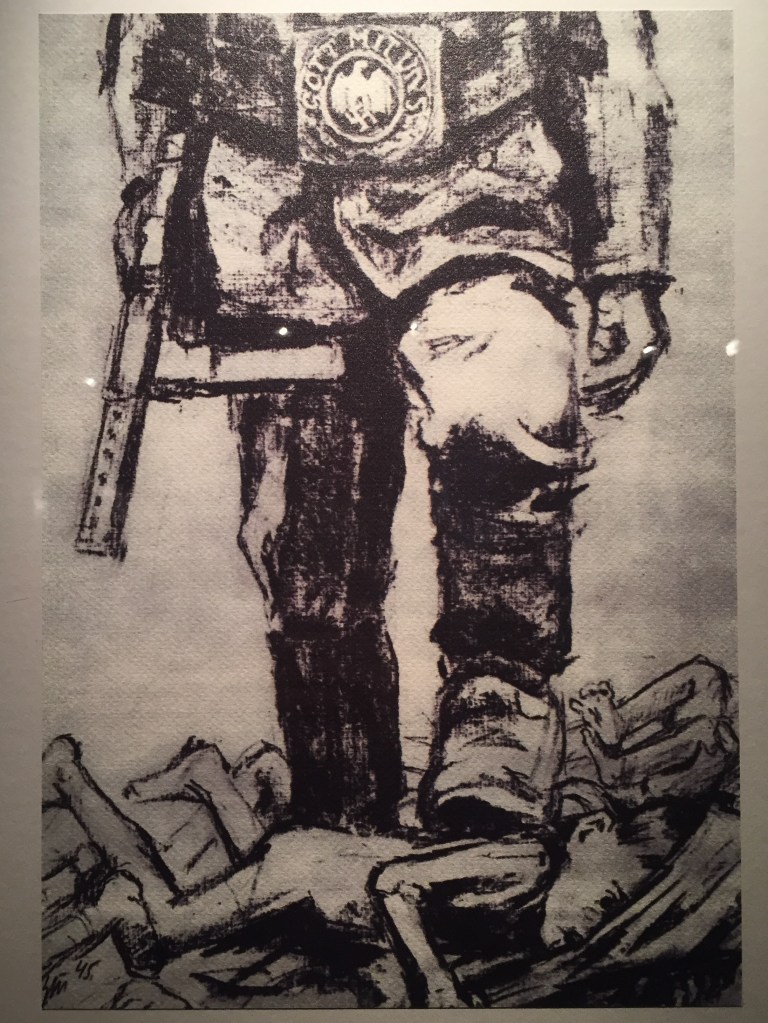
Particularly mesmerising is the art work of a Ukrainian soldier who was among the liberating troops. He drew sketches of the horrors they discovered upon entering the camp. When he ran out of paper, he took some from the Commandant’s office. Instead of turning it over and using the blank side, he opted to incorporate the Nazi letterheads and logos into his drawings.
Birkenau
Auschwitz is actually quite small. Once the camp could no longer deal with the numbers being sent, a second, much bigger camp; Birkenau was built. Prisoners were also held here, but its main function was as an extermination camp.
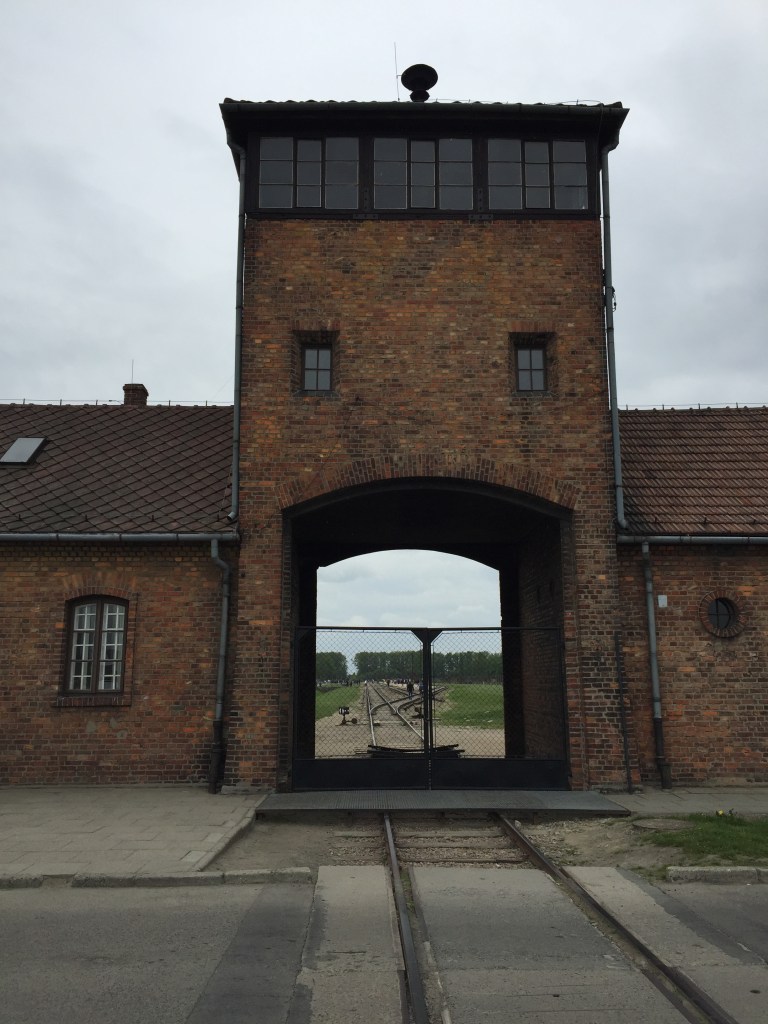
Auschwitz and Birkenau are about 1.5 miles apart. There is a shuttle bus taking visitors between the two camps. Most of Birkenau was destroyed, but a visit to the remains can help to understand the scale of what happened here.

At Birkenau, the railway line runs right through the main entrance to the rear of the camp, stopping at a platform next to the gas chambers. Many of the prisoners sent here were marched straight from the train to the gas chambers, relieved of their possessions/clothes/hair and slaughtered. Their bodies were then cremated. Initially, the ash was used to fertilise the camp gardens, but later it was just shovelled into the nearby lake. The lake is still pitch black with the ash of those murdered here.

The Tatra Mountains
From Auschwitz, we head for the Tatra Mountains, which sit between Poland and Slovakia. We stop for dinner in a pizzeria too far off the tourist trail for English menus to be an option, so it’s a case of pizza Russian roulette. Because of my nut allergy, I rarely buy food without checking the ingredients thoroughly, but I figure I’d have to be spectacularly unlucky to accidentally order a hazelnut pizza. We opt for a Vampira, which turns out to be a really tasty mixture of salami, onion and masses of chillies on a spicy tomato and cheese base. I’m not sure about vampires, but I shall avoid naked flames for a while, as my mouth seems to be on fire.
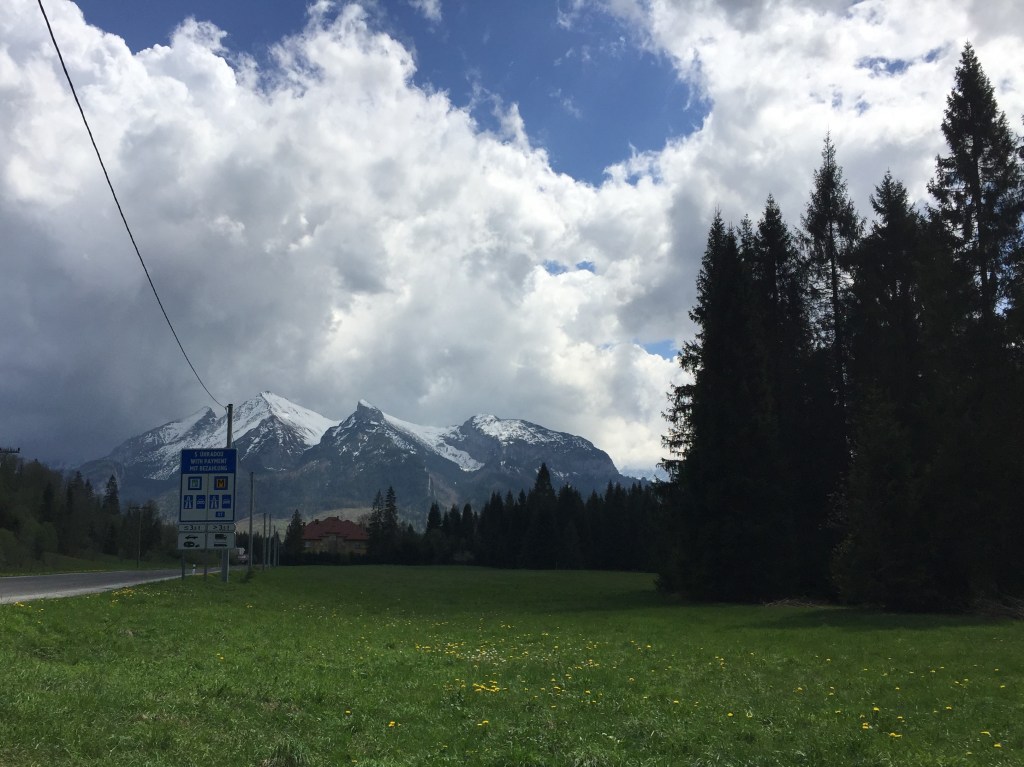
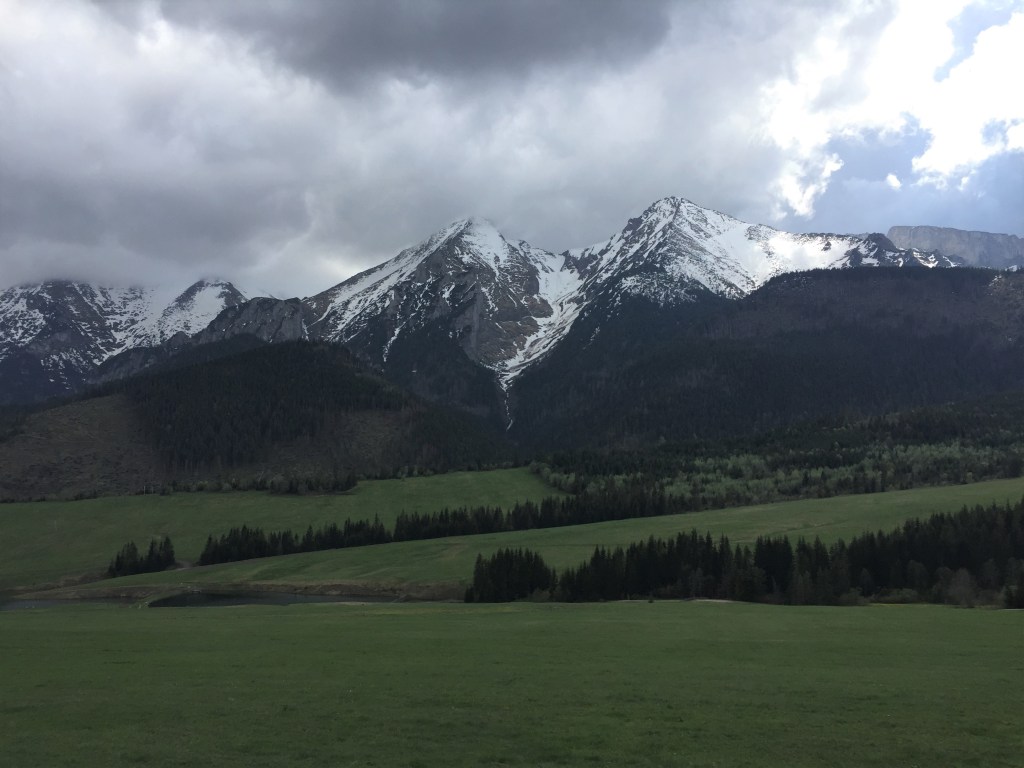
We drive the final 65 miles through picturesque countryside, up into the mountains to the Slovakian border. There is no border control but you know you’re in Slovakia when the nice, smooth road runs out and you’re suddenly bouncing around, swerving to avoid potholes.
Poland Day 3 – The Tatra Mountains to Kraków
Today, we wind our way back down through the mountains and towards Kraków.
Kraków
Kraków is the second largest and one of the oldest cities in Poland. This historic royal city was the capital of Poland until 1596 and is now a UNESCO World Heritage Site.
We spend our first day in Krakow exploring the Old Town, starting at Wawel Royal Castle and working our way up through the Old Town to the Barbican at the top. In a straight line, this is a distance of just a mile, but be prepared to do a lot more walking as you wander around, taking in the sights.
Wawel Royal Castle
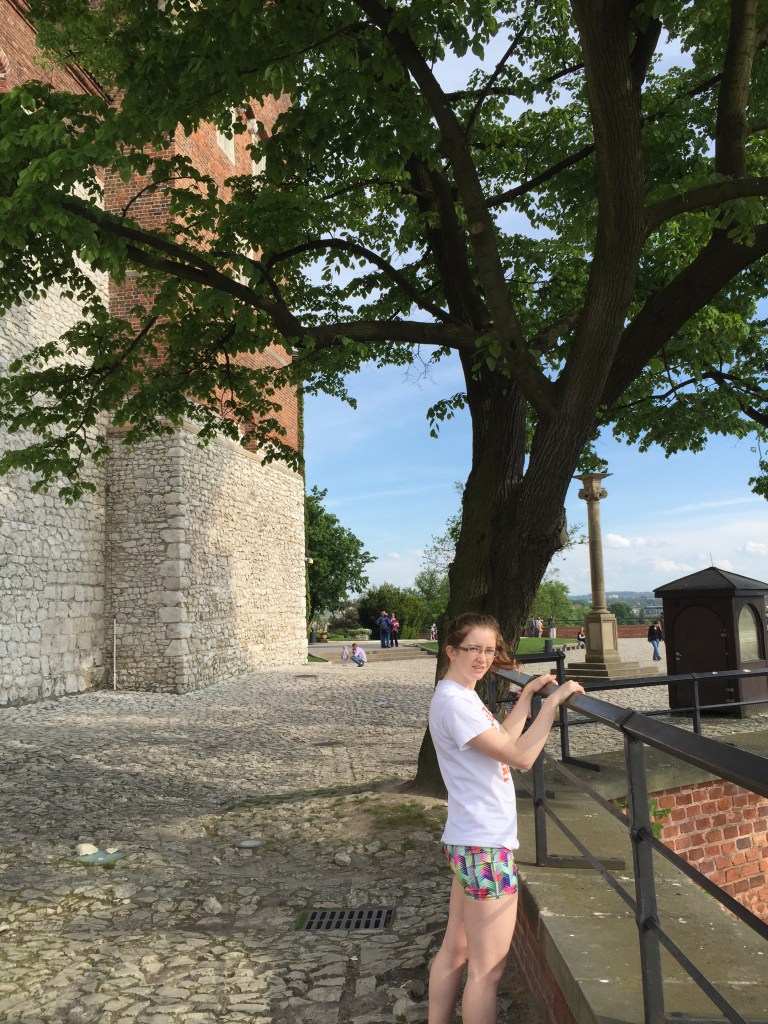
Dominating the city skyline is Wawel Royal Castle. The sprawling 16th Century castle sits on a hill overlooking the city and can be reached via a path up the hillside. The castle is now a museum containing several separate sections including the Crown Treasury, State Rooms, Royal Private Apartments, Lost Wawel and Wawel Underground. Sections require separate tickets, with a bewildering range of combinations available. Or, you can do like we did and just wander around the imposing castle grounds for free.
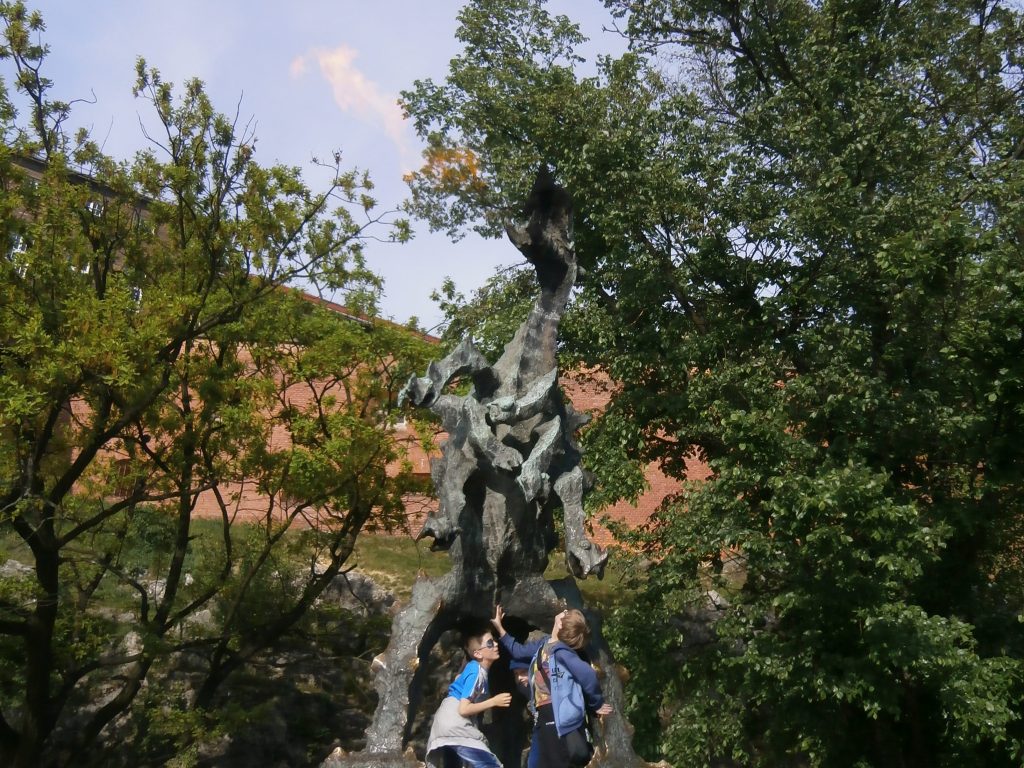
Wawel Dragon
Don’t miss the fire breathing Wawel Dragon, which, surrounded by giggling children, spews forth flames every few minutes.
The castle museums are open daily. More details about opening times and ticketing can be found here.
Wawel Cathedral
Wawel Cathedral sits inside the castle complex. With parts of the building dating back to the 14th Century and other more recent additions, the cathedral has a unique, eclectic appearance.
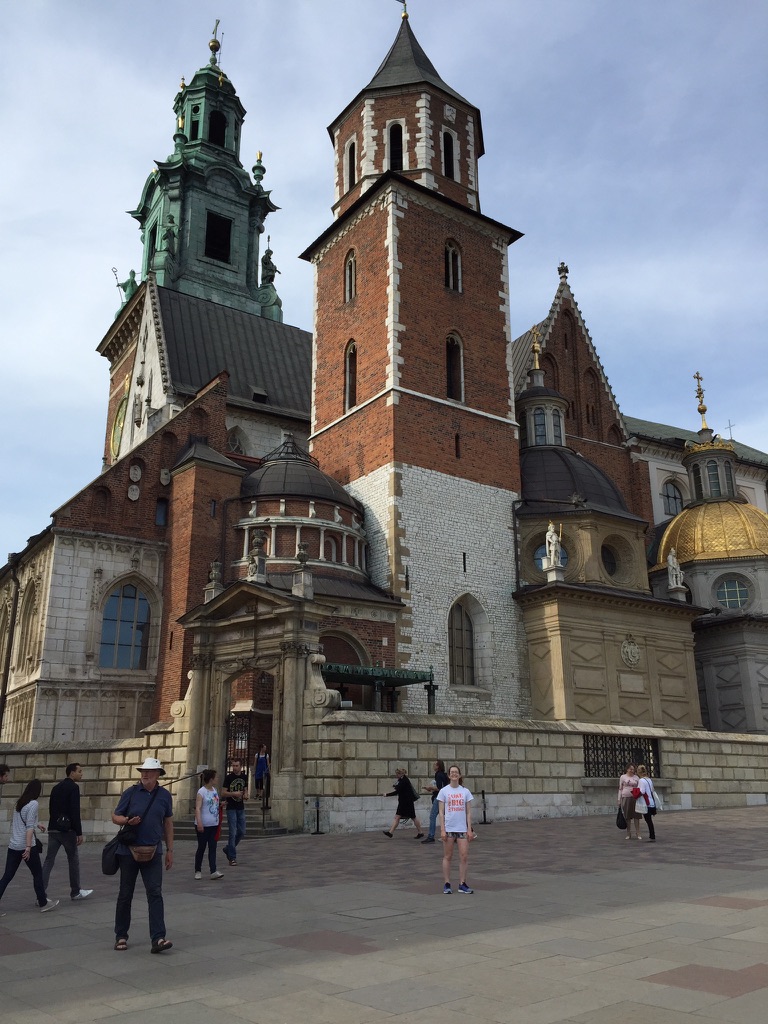
Inside, once you have passed the fabled bones of the Wawel Dragon, you can admire the Cathedral’s ornate interior. For a fee, you can also climb the tower to see Sigismund’s Bell, descend into the Royal Tombs and visit the Cathedral Museum and the Archdiocesan Museum.
The cathedral is usually open daily, with the exception of the museums, which are closed on Sunday or Monday. A standard combination ticket costs 25 PLN (around £5). More details about opening times and ticketing can be found here.
Rynek Główny (Main Square)
The vast Rynek Główny (Main Square) dates back to the 13th century and is the focal point of the Old Town. Measuring 200 metres by 200 metres (a total of 9.4 acres), it lays claim to being the largest medieval town square in Europe.
The Square is surrounded by historic townhouses (many now housing hotels, restaurants and bars, with tables spilling out into the square) and churches, as well as the Town Hall Tower. The centre of the square is dominated by the Sukiennice (Cloth Hall). The square also houses the 19th Century Adam Mickiewicz Monument (a Polish poet) plus the considerably more modern Eros Bendato.
Eros Bendato
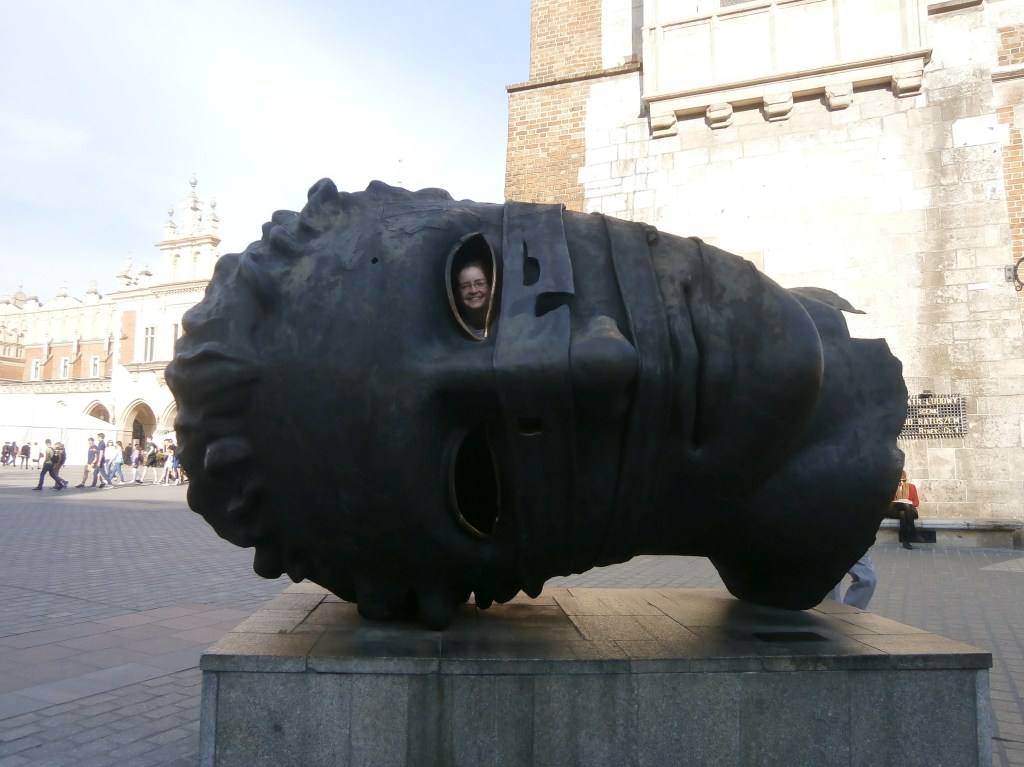
In the south west corner of the Square, Eros Bendato, known locally as ‘The Head’, is a controversial 2005 addition to the Square. The sculpture is the work of Polish artist Igor Mitoraj depicting the head of Eros, the Greek god of love, wrapped in bandages and laid horizontally. It has become a popular photo op, with children (and adults) keen to clamber inside.
Sukiennice (Cloth Hall)
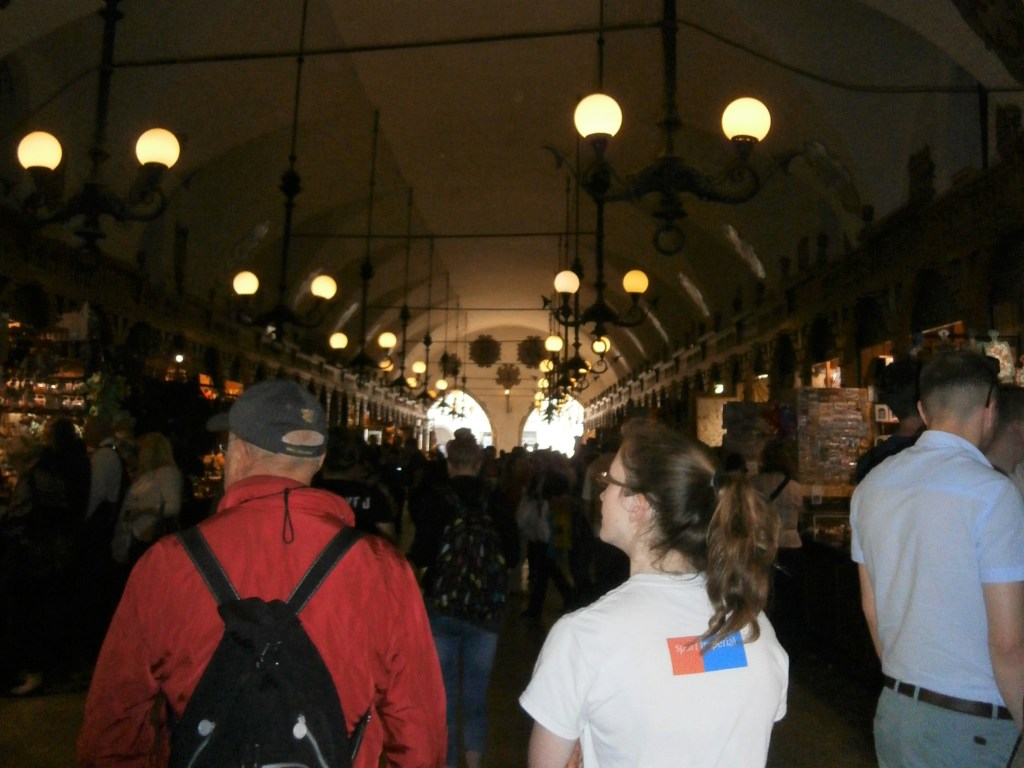
In the centre of the Main Square is the medieval Sukiennice (Cloth Hall). Rebuilt in the 16th Century after it was gutted by fire, the hall was originally constructed in the 14th century as a centre for cloth trade. The building is designed in the Renaissance Style, topped by a parapet decorated with carved masks. The arcades were added in the 19th century. Today, the hall houses stalls selling handicrafts and souvenirs. Hence, the Sukiennice has been a hub for trade and commerce for several centuries.
Rynek Underground
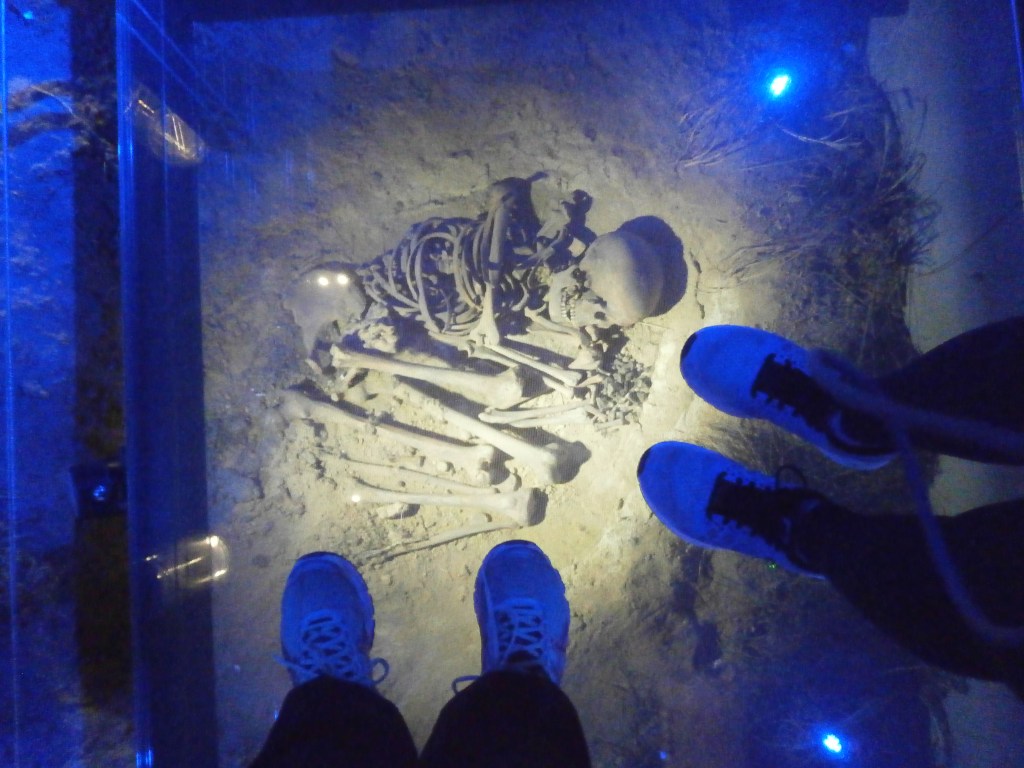
Rynek Underground is a museum telling the history of Krakow, which is actually situated underneath the Main Square. Entering the tunnels near the end of the Cloth Hall, you can see a fascinating combination of ancient remains and modern audio visual displays.
The museum is open most days from 10 am, with closing times varying. Adult entry costs 40 PLN (around £8.10). Further details about opening times and ticketing can be found here.
St Mary’s Basilica
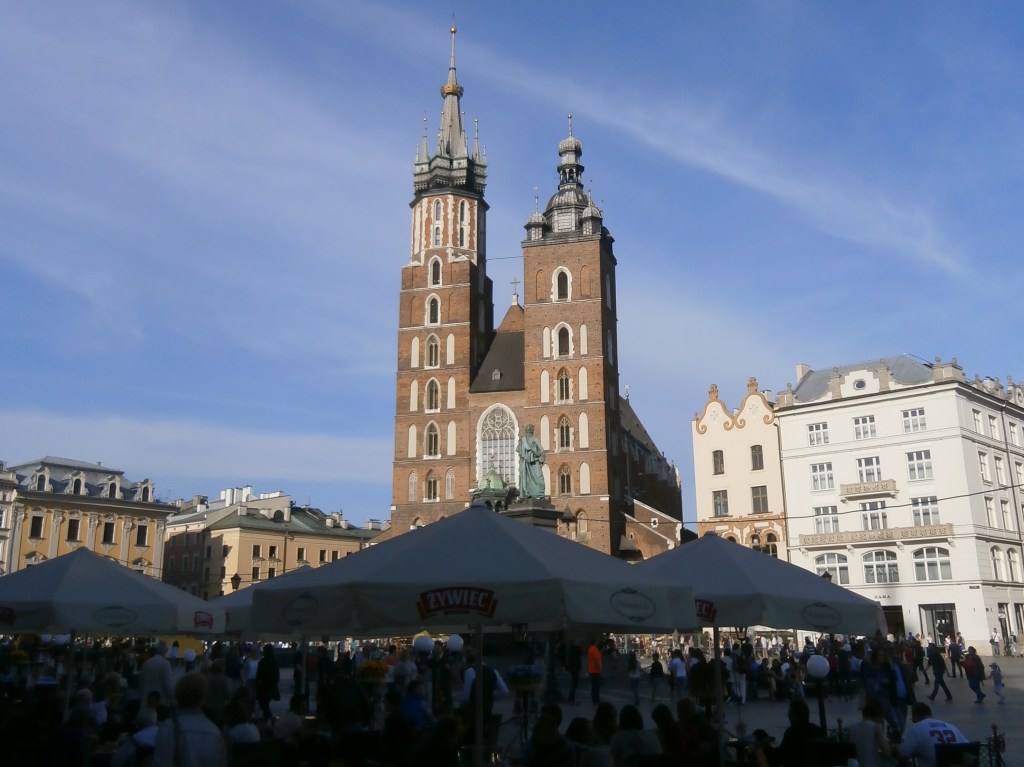
Overlooking the Main Square is St Mary’s Basilica with its distinctive uneven towers. The first church was built in here around 1220. Following its destruction during a Tatar raid around forty years later, construction of the current basilica began. The grand entrance, through an 18th Century baroque portal, is used solely by worshippers. Tourists must enter through the side door.
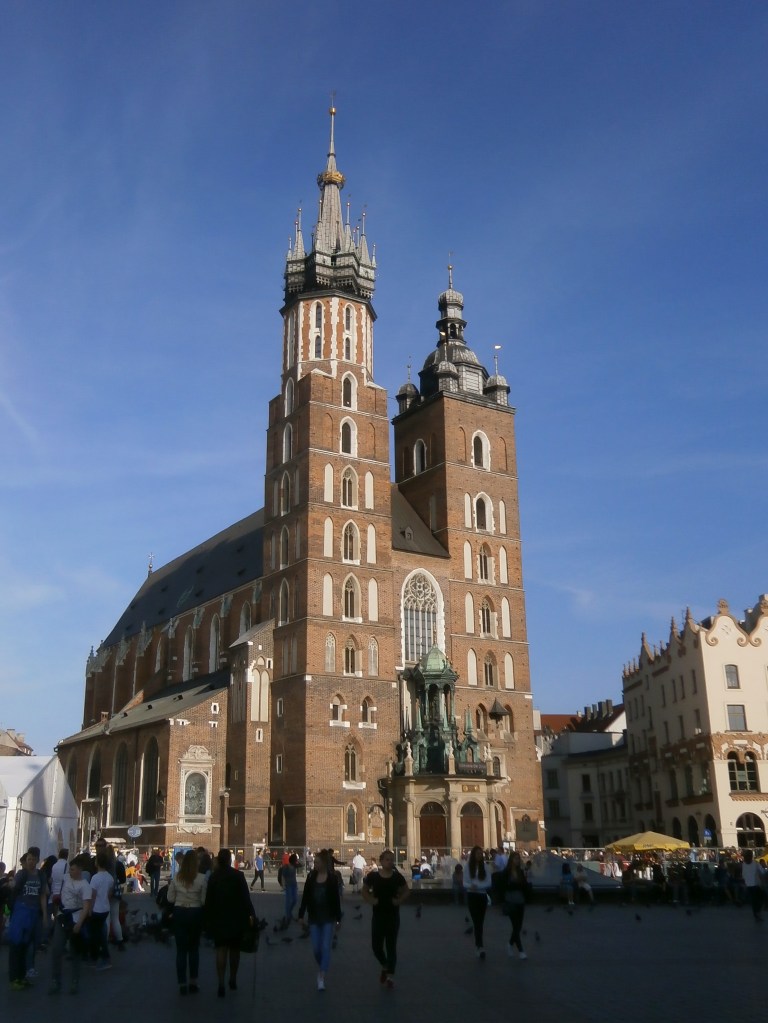
You can tour the exquisite interior with its spectacular carved wooden altar. Don’t miss the hourly hejnał (bugle call), which sounds from the taller tower.
The church is open to visitors daily from 11.30 am (2 pm on Sunday) until 6 pm. A donation of 18 PLN (around £3.70) is requested. Further details about opening times and ticketing can be found here.
Barbican
The Barbican, at the northern end of the Old Town, formed part of Kraków’s medieval fortifications. The circular bastion, topped by seven turrets, has 3 metre thick walls interspersed with 130 loopholes. The Barbican dates back to 1498, when it was built to protect the nearby Florian Gate. It now houses a small museum.

Drinks at a Vodka Bar
After a busy day’s sightseeing, start the evening off by trying some of the wide range of vodka available at the myriad of Vodka Bars around the old town. We opted for cherry vodka, which was very pleasant.

Dinner at Czarna Kaczka (The Black Duck)
For dinner, we chose the Czarna Kaczka (The Black Duck), which specialises in duck dishes. I opted for the duck breast with red wine sauce, dumplings stuffed with red cabbage and dried plum, which was delicious.

Accommodation: Rembrandt Aparthotel
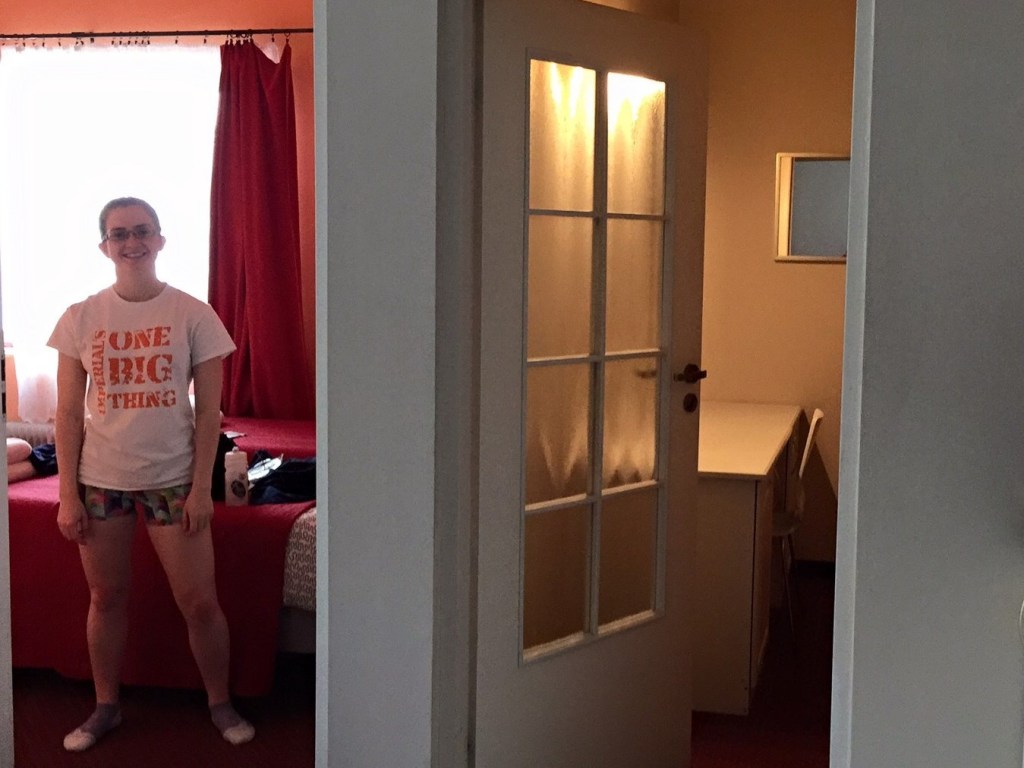
If you want to stay in the heart of the old town, The Rembrandt Aparthotel is a great option. Centrally located in a historic building, these well equipped, comfortable apartments are just a few minutes walk from Kraków’s main attractions with plenty of great bars and restaurants nearby.
Poland Day 4 – Kraków to Warsaw
Today, we are heading for the capital, Warsaw. The road to Warsaw is indeed mostly road (I had expected motorway, but there are only chunks of motorway appearing randomly along the way). Hence, the 184 mile journey takes over five hours. It’s not very scenic and I’ve finished my book, so it’s a long five hours. We stop briefly at a Lidl to buy brunch and get attacked by an old lady brandishing a shopping trolley like a lethal weapon.
Warsaw
By the time we reach Warsaw, it’s mid afternoon and raining and the city is masked by a cloud of smog. It takes another hour to fight our way into town (I can understand now why we had to pay an excess to bring the car here – the drivers are batshit crazy).

Palace of Culture and Science
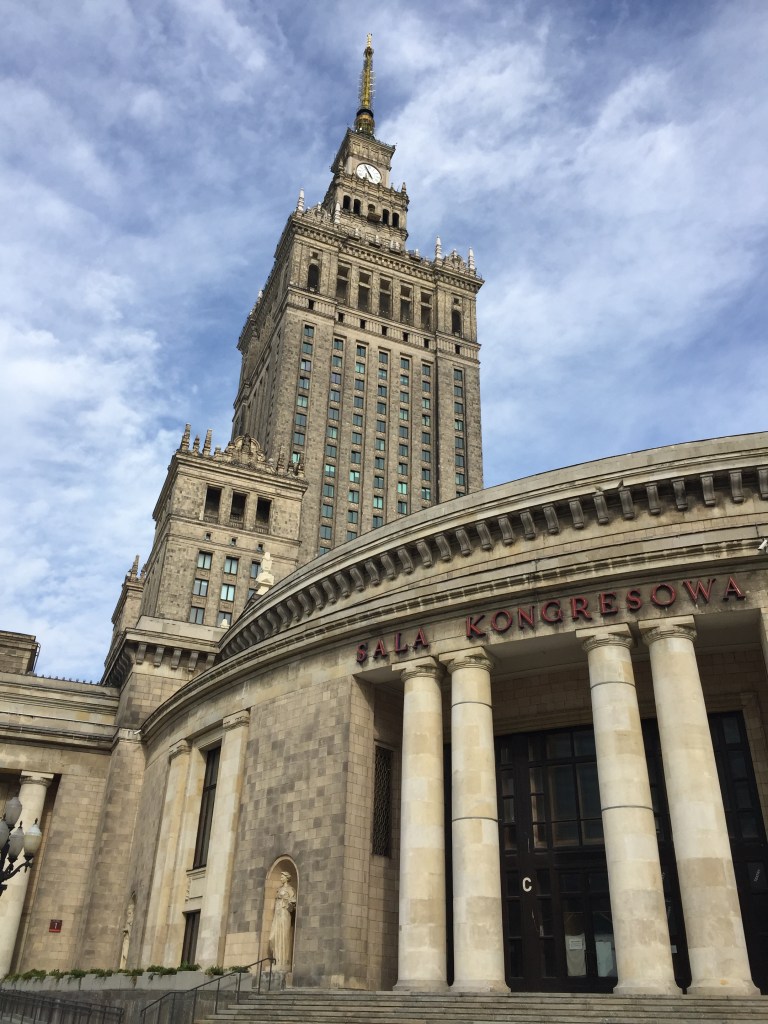
We start our afternoon of sightseeing at the Palace of Culture and Science; an enormous building – the tallest in Poland. Gifted by the Soviet Union in the 1950s, it is true to Stalin’s crazy gothic/socialist realist style.

You can take a lift to the 30th floor to admire the view of the city. However, it takes forever to reach the front of the lift queue due to the huge number of people and our inability to hold our ground in a crowd. Eventually, we reach the top and can admire the views. The wait to descend takes even longer.
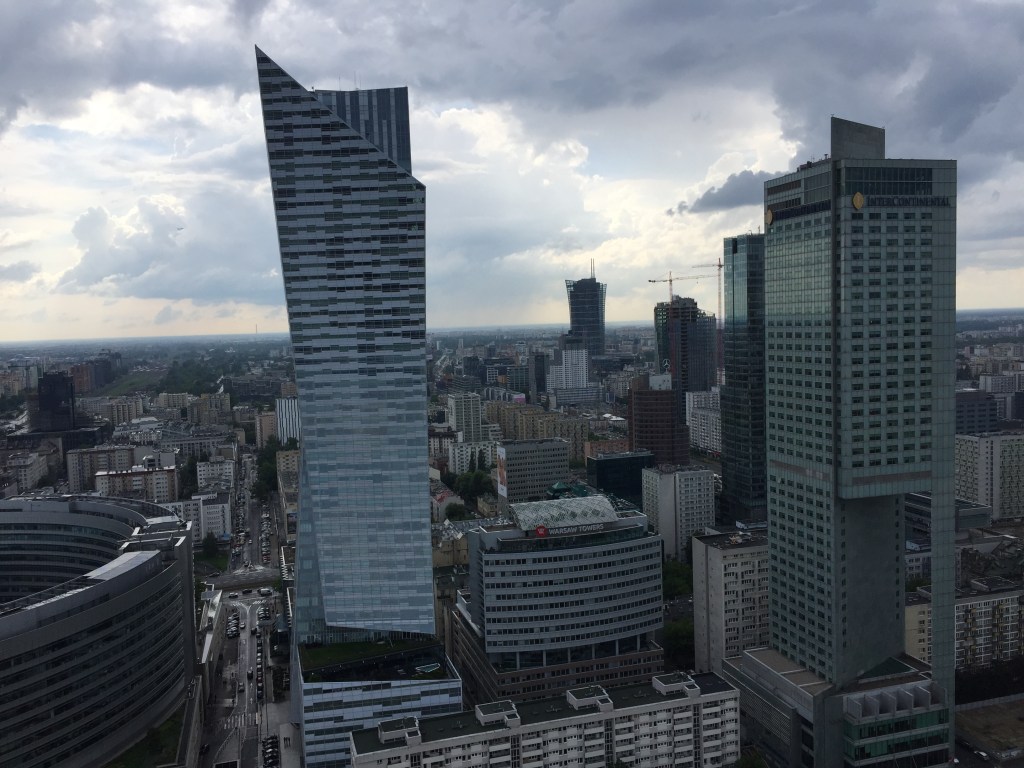
The Viewing Terrace is open daily from 10 am until 8 pm. An adult tickets costs 28 PLN (around £5.80).
Once down, the old man decides to visit an exhibition of metal sculptures. I opt instead to take a walk around the building. The fact is, it’s so tall, I’ve completely misjudged how big it as ground level (it houses a range of theatres, a cinema, museums, restaurants, bars and clubs). Walking round the base takes quite a while.
Warsaw Ghetto Wall
On the way round, I pass a plaque which marks the remains of the Warsaw Ghetto Wall.

Twenty minutes later, I have completed my circumnavigation of the Palace of Culture and Science to find the old man sitting on the steps waiting and huffing.
Saxon Park
Next stop the old town, via the pretty Saxon Park with its lakes and gardens.

Tomb of the Unknown Soldier
The park also houses the Tomb of the Unknown Soldier. The tomb was erected after WW1 and contains the unidentified body of a young soldier who fell during the Defence of Lwów. It is lit by an eternal flame and has a military guard. There is a changing of the guard on the hour every hour.

Old Town
We wander round the Old Town, which is very picturesque. Now a UNESCO World Heritage site, the area, which can trace its origins back to the 13th Century, was almost totally destroyed during World War II.

Royal Castle
The huge, red brick Royal Castle dates back several centuries, although the current building is a post-war reconstruction.

It is possible to visit the royal apartments and various galleries within the castle, as well as the royal gardens. Further details can be found here.
St John’s Cathedral
St John’s Cathedral, another post war reconstruction, was originally built in the 13th century and has been the site of royal coronations and other national celebrations.

Dinner at Specjaly Regionalne
After taking plenty of photos, we stop for dinner at Specjaly Regionalne; excellent local cuisine including duck pierogi washed down with a Polish beer or two. Then back to the hotel to bed.

Accommodation: Mamaison Residence Diana
Tonight’s hotel is Mamaison Residence Diana. It’s a lovely hotel. The building is 19th Century, but inside is sleek and modern with well equipped apartments. The hotel is tucked down a side street, so we found it rather difficult to locate. There is on site parking, although reaching it involved driving down a pedestrian street and through an archway a few centimetres wider than the car. Once you’ve found it, the hotel is conveniently located, just a 10 minute walk from the Palace of Culture and Science.
Day 5 – Gdańsk
I’ve been looking forward to today’s visit to Gdańsk. Having studied East European Studies at University, a visit to the European Solidarity Centre is the highlight of my trip (yes, I know I’m weird).
We set off on the 7/S7/E77/DK7 ‘sometimes I’m a road, sometimes I’m a motorway’ combo. It takes four hours to reach Gdańsk – we have now driven the length of Poland, from the Tatras to the Baltic.

Gdańsk holds a pivotal place in European history. As the German city of Danzig, it was a major port and shipbuilder. After WW1, it became part of Poland. In 1939, when Hitler invaded Poland, Gdańsk was at the top of his ‘to do’ list. In fact, the first shots of WWII were fired here – in Westerplatte, a peninsula around 6 miles north of the old town.
Then, in the 1980s, Lech Wałęsa’s Solidarność movement emerged and became the catalyst to the ending of Communism in Eastern Europe. All of these influences are visible on a visit to the picturesque city of Gdańsk.
European Solidarity Centre
We head straight to the European Solidarity Centre; a museum charting the history of the Polish Solidarity Movement, which was so pivotal in the overthrow of Communism and hence the shaping of today’s political landscape.

There’s plenty of memorabilia on display; Lech Wałęsa’s Solidarity Membership Card, the crane he stood on to speak to workers, the shipyard gates crushed by the militia, the popemobile Pope John Paul used on his visit etc. I spend hours wandering around, taking it all in.
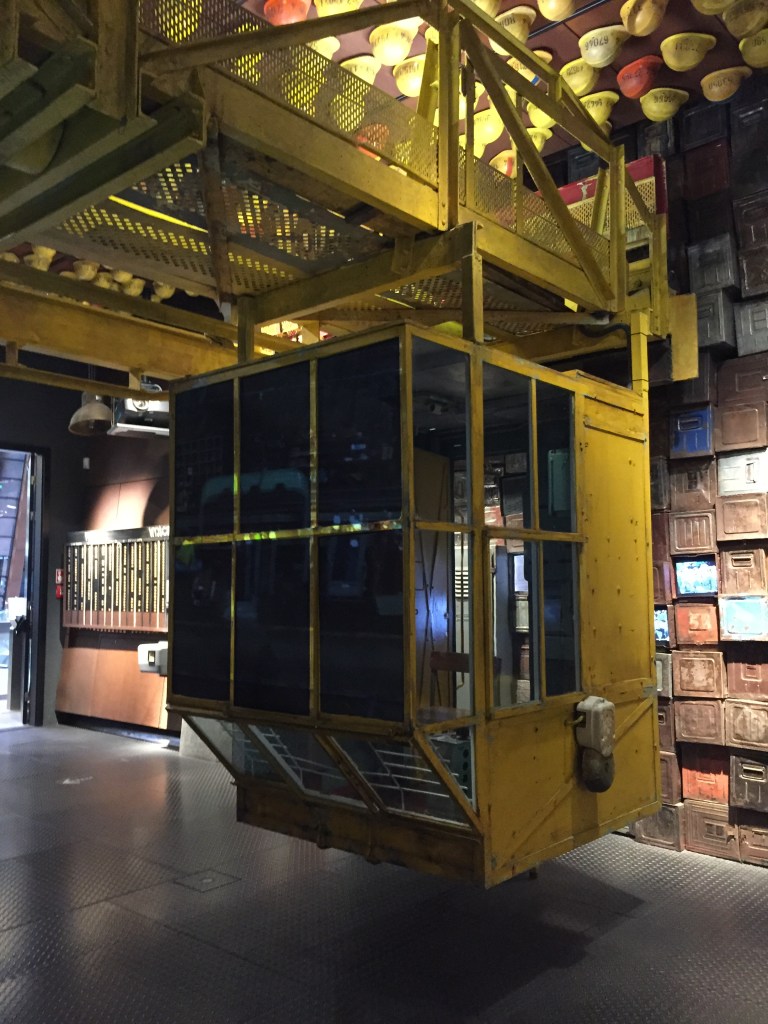
I find it fascinating. The old man opts for a whistle stop tour then plays Candy Crush in the lobby until I’m ready to leave.

Outside, is the Monument to the Fallen Shipyard Workers of 1970. This pays tribute to the workers who died when unrest at the dock was violently suppressed.
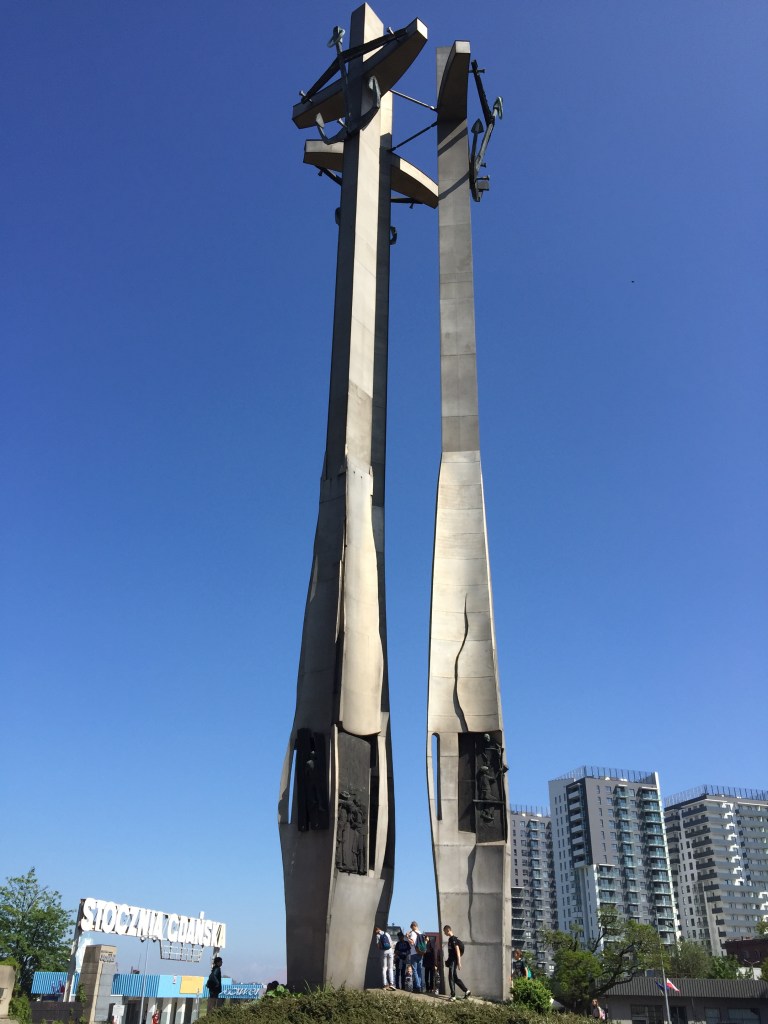
The European Solidarity Centre is open daily (except Tuesdays between October and April). Opening hours are seasonal. Further details can be found on the website. Admission costs 35 PLN (around £7.10). The price includes a two hour guided audio tour through the exhibition.
Gdańsk Old Town
From here, we head to the Old Town, which lines the waterfront with a combination of original Hanseatic merchant buildings and modern conversions, which all adds to the city’s charm.

Żuraw
Dominating the Gdańsk waterfront is the Żuraw; a 15th Century crane, once the largest crane in medieval Europe. The crane could lift four tons of cargo, powered by groups of men, who would walk round two large wooden wheels, rather like giant hamster wheels.
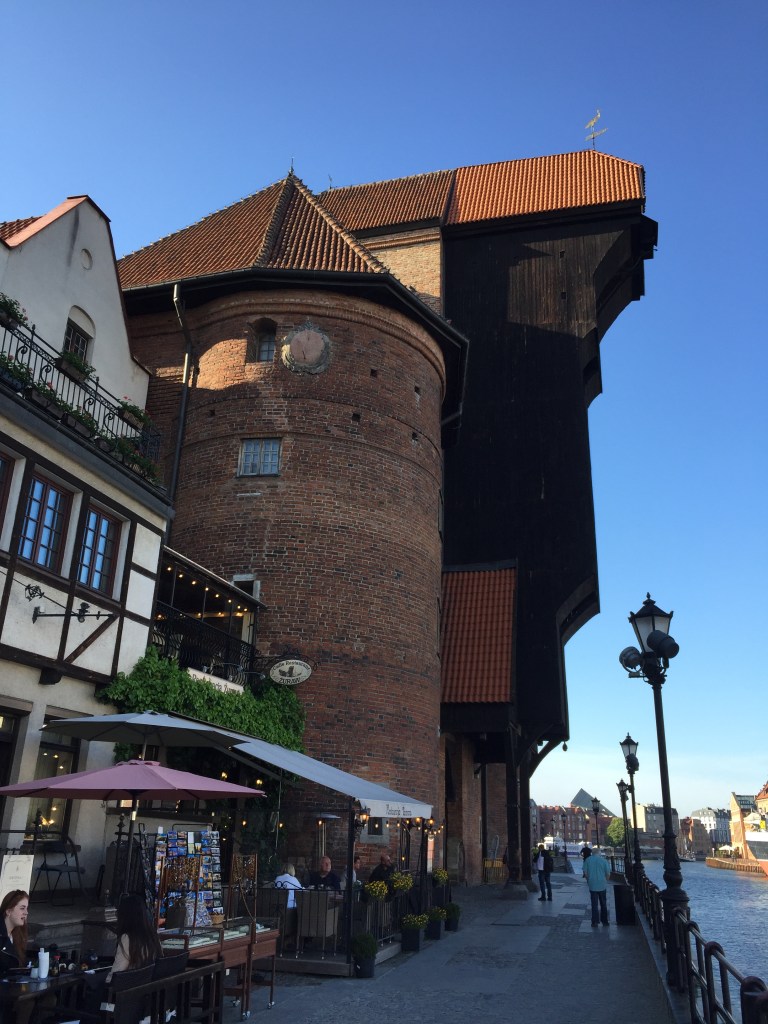
The Żuraw is part of the National Maritime Museum, which you can visit if you have sufficient time (which we didn’t). The museum is across the river from the crane and can usually be reached by ferry (although the ferry isn’t currently running).
Motława River Waterfront
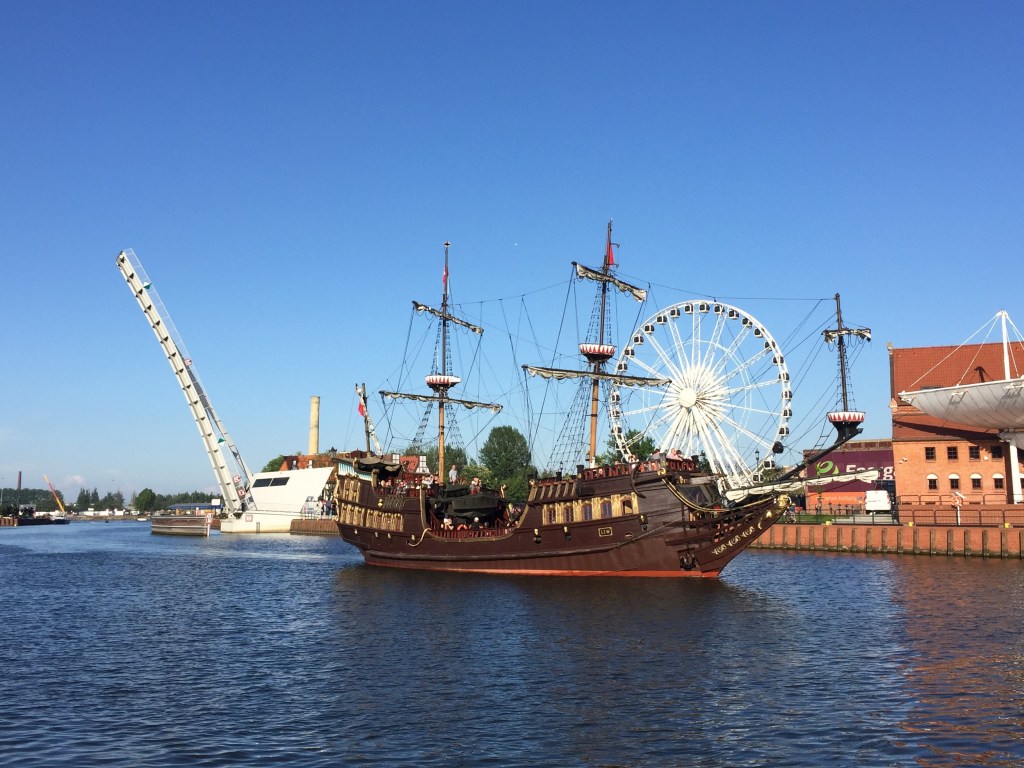
We follow the path along the Motława River Waterfront as far as the pedestrian swing bridge across the river to the other shore, where there is a park, big wheel and neon Gdańsk sign for that all important photo op.
Mariacka Street
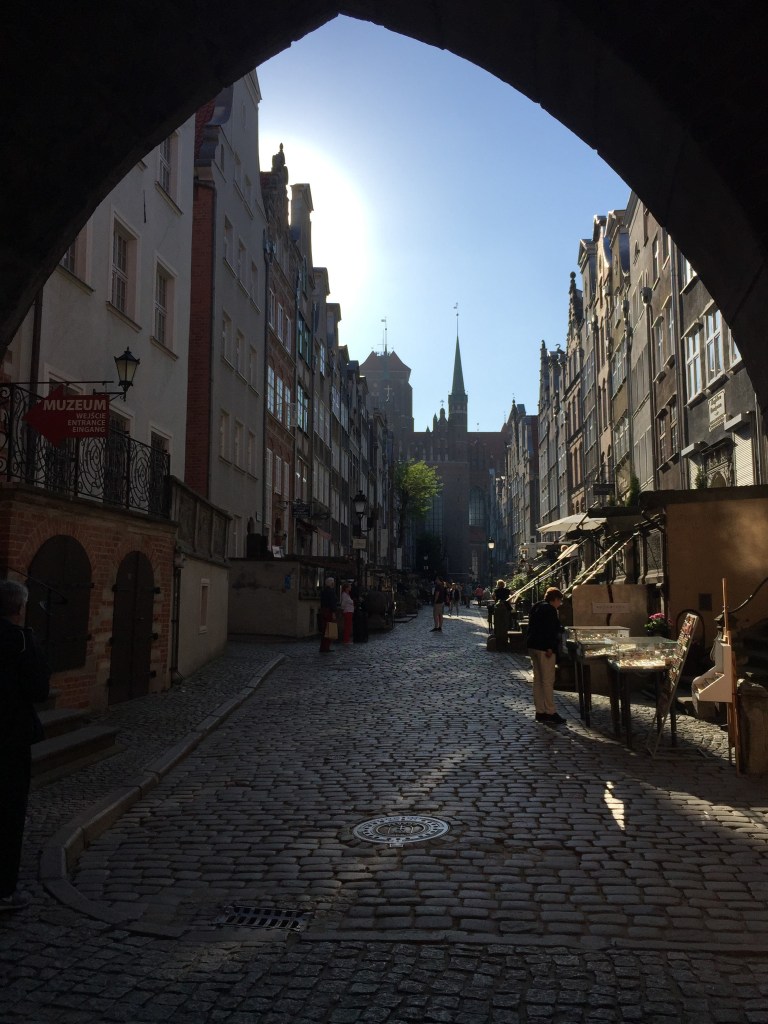
Back on the southern bank, pass through St Mary’s Gate and you are in photogenic Mariacka Street, with its cobbled streets and coloured terrace houses. This touristy street, once the domain of wealthy merchants, now lined with restaurants, runs from the waterfront to St Mary’s Basilica.
St Mary’s Basilica
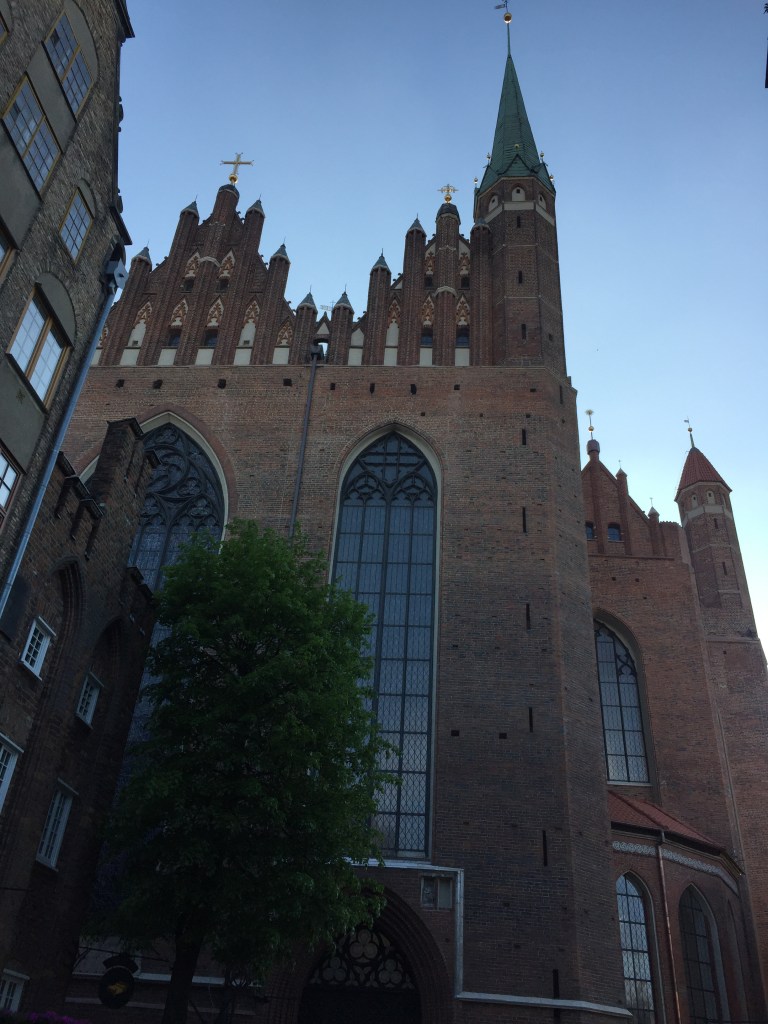
The 14th Century St Mary’s Basilica is one of the largest brick churches in the world. Its 78 metre high tower is impressive to look at, but difficult to photograph in the narrow streets.
Długi Targ
Head a couple of blocks south to the equally touristy Długi Targ (Long Market). Once the city’s main market street, it is now lined with bars, restaurants and souvenir shops.

Neptune’s Fountain
The bronze Neptune’s fountain in Długi Targ dates back to the 17th Century. A fig leaf was added to protect Neptune’s modesty some 350 years later.

Main Town Hall
Half way down Długi Targ, you will find the Main Town Hall with its 81 metre high tower, which you can climb in summer for a view across the city. The building now houses a museum, part of the Museum of Gdańsk.

Ice Cream from Grycan
And that concludes our whistle stop tour of Gdańsk. Just time for an enormous ice cream from Grycan and it’s time to head back to the hotel. I wish we’d planned to stay more than one night here. But we have to move on tomorrow, so that we’re in a town beginning with Z by Saturday…

Accommodation – Hotel Number One by Grano Gdańsk
Our hotel tonight is Hotel Number One by Grano Gdańsk. We have received a message from them saying that it is a ‘very new’ hotel and they ‘hope we are up to the challenge’. Sounds ominous. I suspect it translates to ‘you’re sleeping in a building site – we did warn you!’ But it’s actually really nice. It’s located on an island in the river, which consists mainly of derelict warehouses, just starting to be regenerated. We purchase supplies from a nearby shop and have a picnic dinner on our hotel room balcony.
Day 6 – Poznań
It’s time to start heading towards home, stopping tonight at Poznań. Mainly because it’s half way, rather than because my guide book enthuses about Poznań – which it doesn’t.
It’s another four hour drive, but this time we are allowed to stop. To prove we’re living the dream, we have brunch in a KFC in a motorway service station. If there was a prize for the meal which looked least like the photo on the menu, my cheese wrap would win. No matter, I have a bucket of chips…
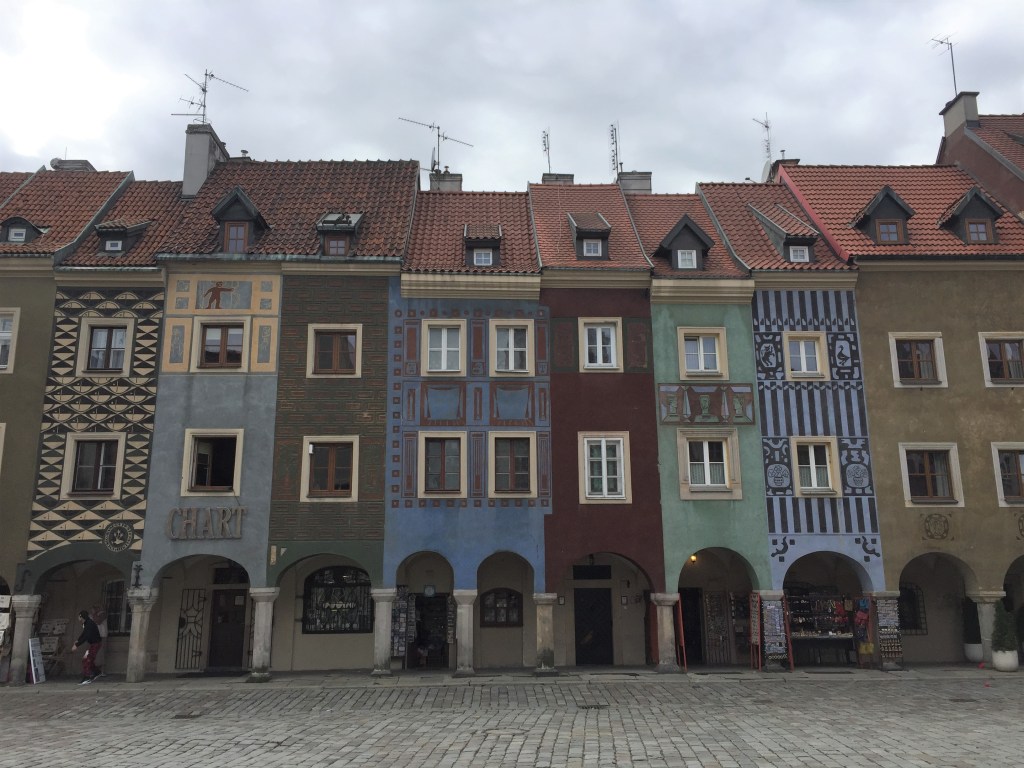
After that healthy interlude, we continue to Poznań, which is a lot bigger than I’d expected. And very fond of one way systems. The best thing about our visit to Poznań is that Lonely Planet have set our expectations to low, so at least we are not disappointed. We set off to explore the old town.
Town Hall
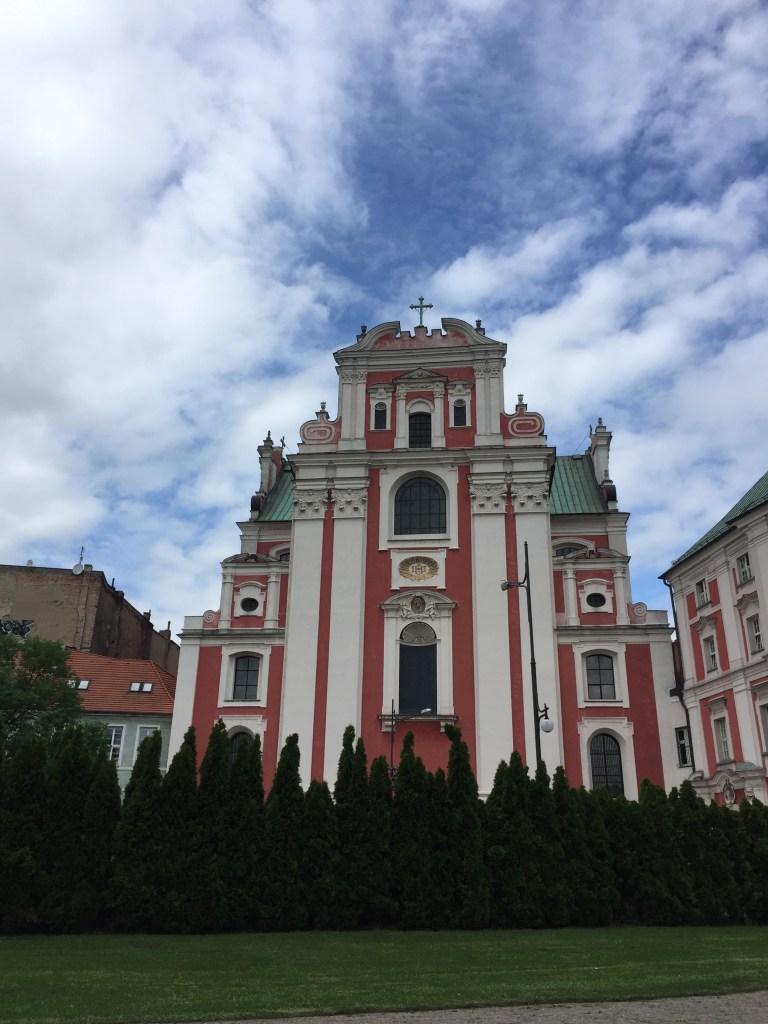
Poznań’s main tourist attraction is the Town Hall – to be more precise, the Town Hall Clock; at midday, two mechanical goats come out of doors on either side and butt horns. Thanks to the traffic, we have missed this, so have to make do with purchasing a tacky fridge magnet with little moving goats.
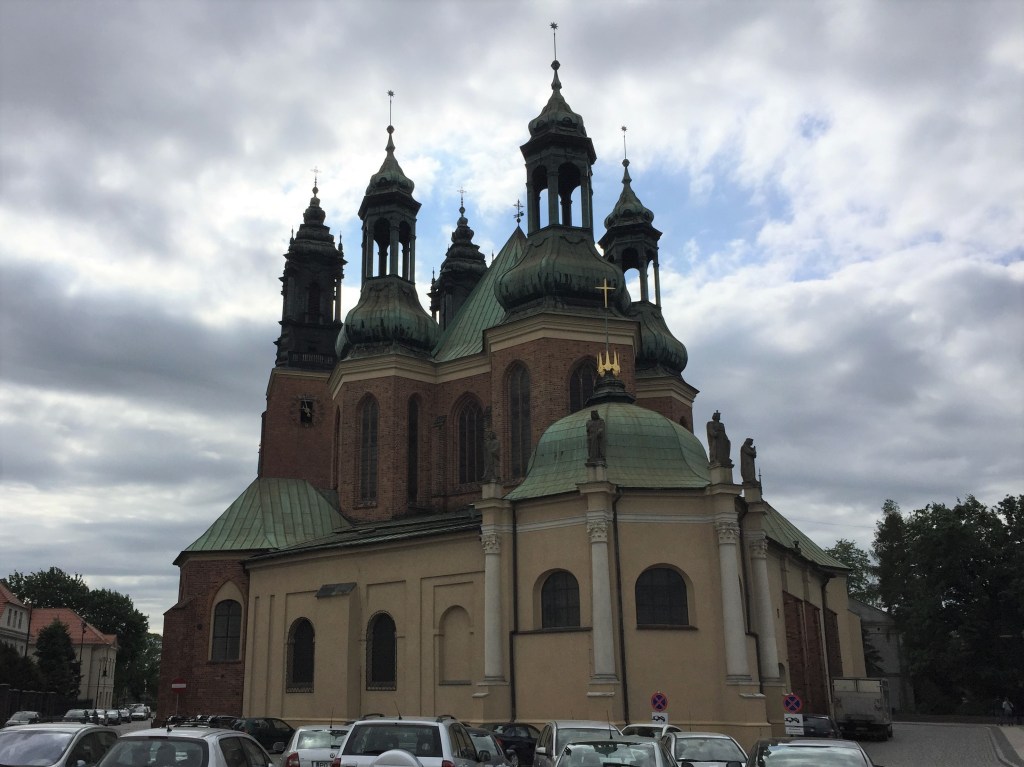
Poznań Cathedral
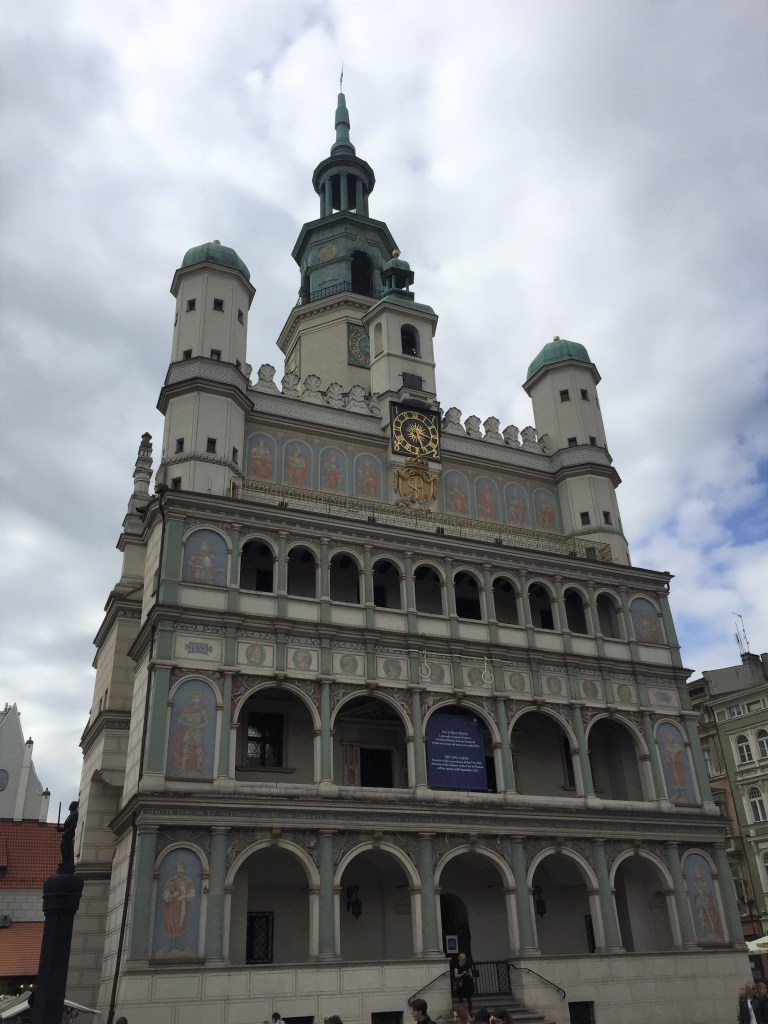
We cross the river to Cathedral Island. Here sits Poznań Cathedral; the first cathedral in Poland. In fact this spot lays claim to the birth of the Poland.
Porta Posnania Heritage Centre
There is an interesting interactive museum, Porta Posnania Heritage Centre, where you can learn about the history of the island and of the Polish Nation.
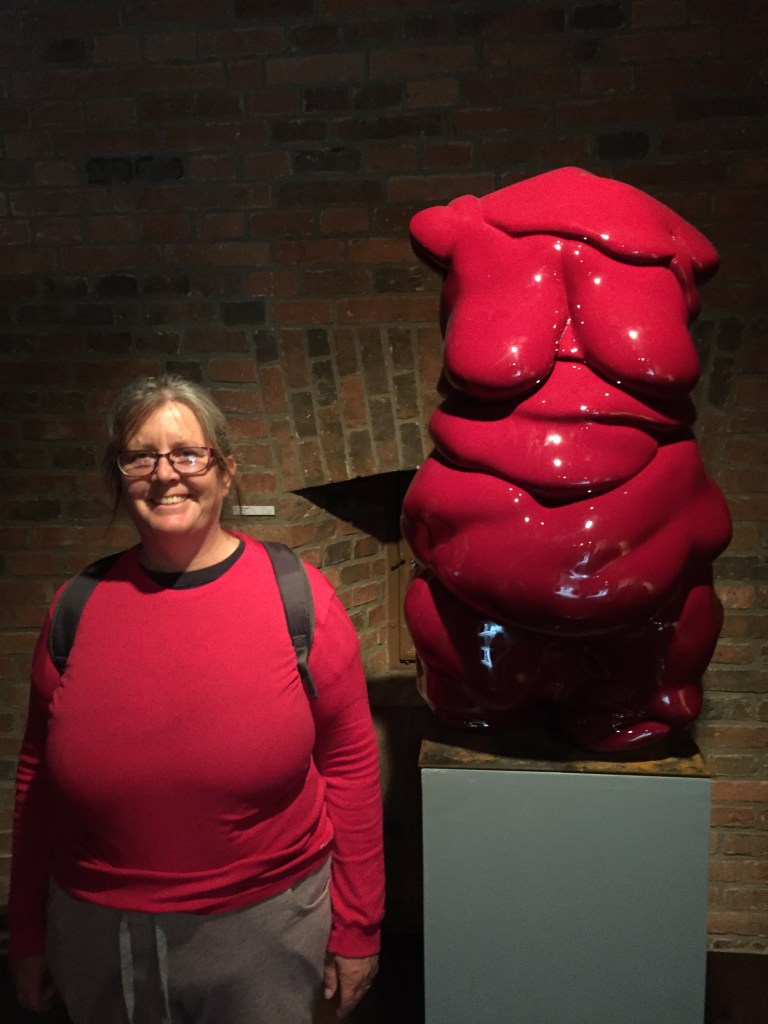
The museum is open daily except Mondays. Adult entry costs 28 PLN (around £5.70).
Dinner at Stary Browar
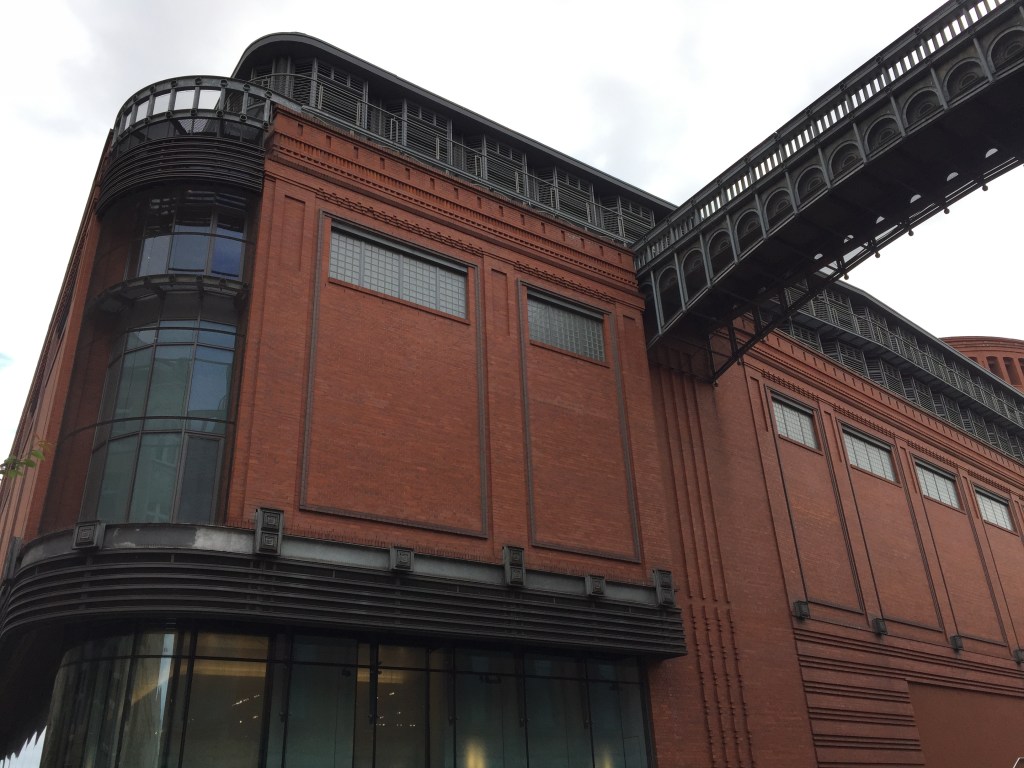
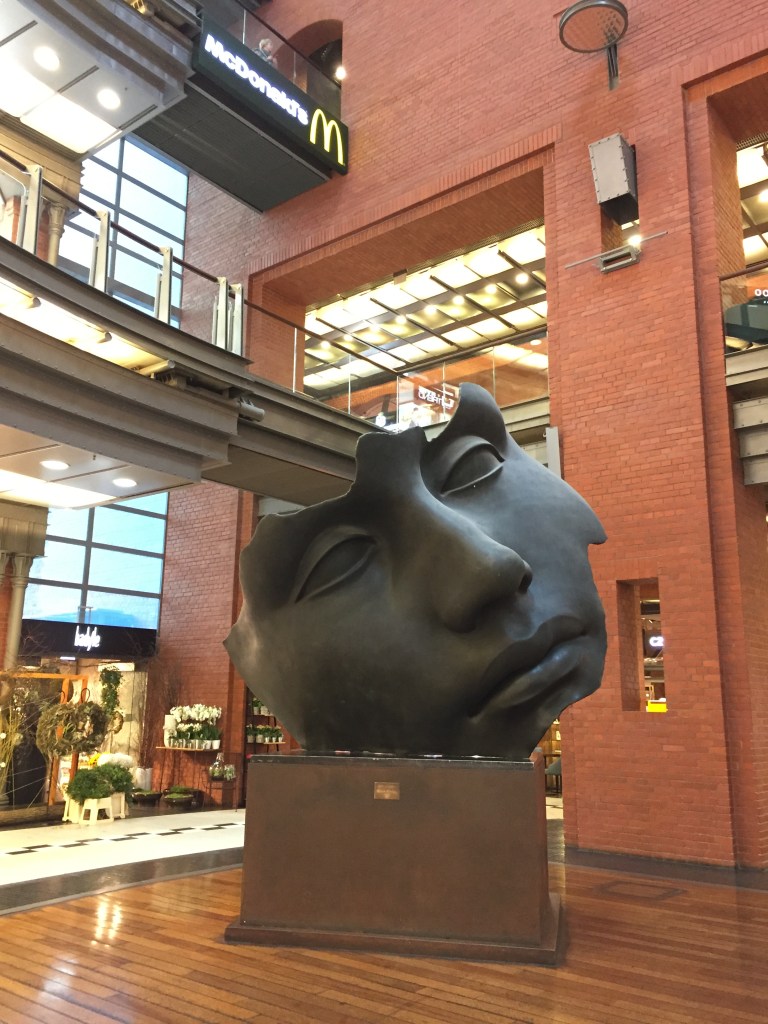
We round off the evening at Stary Browar; an old brewery converted into a funky shopping mall. Here, in the middle of a food court, the old man announces that there is nowhere appropriate to eat within half a mile. I point out that we are in a food court, but he claims that it’s all junk and he wants something healthy. Undeterred by the fact that we’re standing by a salad bar, he sets off in his quest for a ‘healthy’ dinner.
We end up in a Polish fast food joint, where his ‘healthy’ option consists of a pork escalope bigger than his plate, potatoes and a side of coleslaw. There are plenty of good dining options in the Stary Browar.
Accommodation – Hotel Stare Miasto Old Town
Today’s hotel, Hotel Stare Miasto Old Town, is conveniently located, just a 10 minute walk from the Old Town. However, it is in an area with a lot of one way streets. Eventually, we work out that the road our hotel is on has roadworks in the middle. This means that the hotel is only accessible by driving the wrong way down a one way street. The rooms are described as classically decorated. They were clean and comfortable although it all felt a little old fashioned.
Day 7 – Zielona Góra
It’s our last full day in Poland and time to make tracks for Zielona Góra for the old man’s coveted Z parkrun. We initially intended to go to Żary, but there has been much dispute among parkrun nerds over recent weeks on whether Żary should count as a Z, when it actually starts with a Ż. Some argue that a Ż is just a Z with an accent, while the linguistic purists insist that in Polish – it is a separate letter of the alphabet. The purists won and thus our travel plans had to be hastily rearranged.

Winny Park
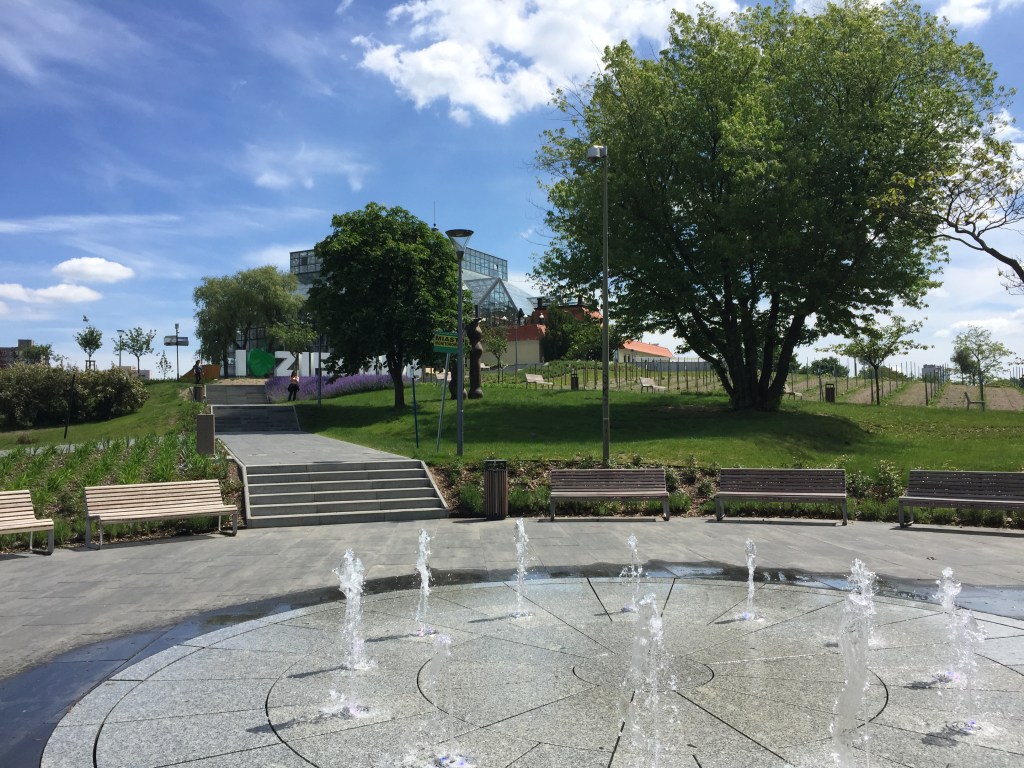
We reach Zielona Góra by midday. It doesn’t even get a mention in my guide book, but it’s a pretty little town. Winny Park, a former vineyard, is full of pink cherry trees, purple verbena and hundreds of Red Admiral butterflies.
Palmiarnia
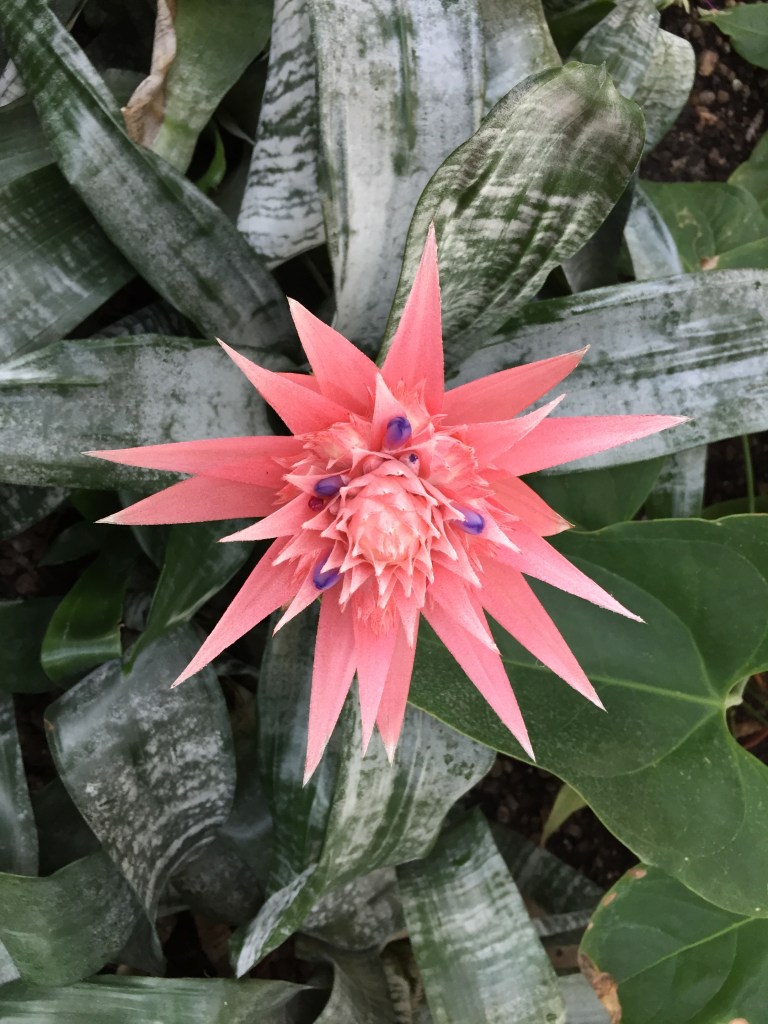
On the outskirts of the park is the Palmiarnia (palm house). The house was originally part of vineyard, being built around the building housing the workers’ barrels and tools. This original palm house dates from 1961. It has been extended twice since this time. On both occasions, to protect the delicate plants, the new structure was built over the the top of the existing building. Once the new structure was glazed, the old one was dismantled by hand.

As well as a display of palms and exotic plants, the building houses a cafe and restaurant, plus an aquarium and a waterfall.
Old Town
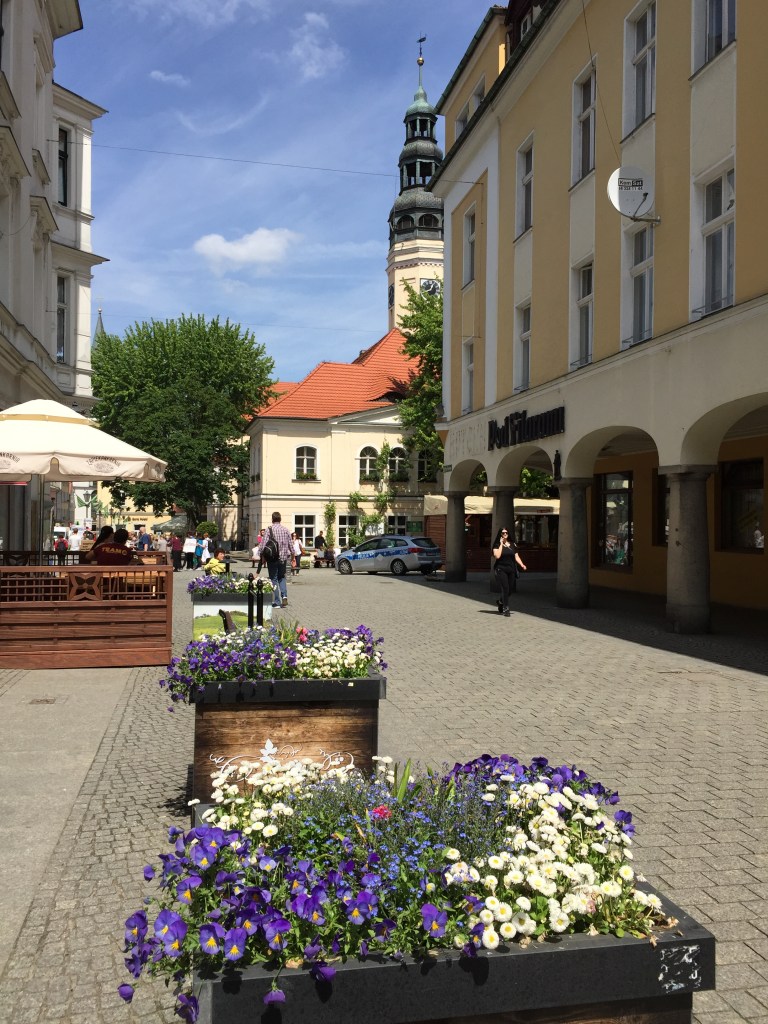
There is also a pleasant pedestrianised Old Town, centred round the Town Square.
Bacchus Statues
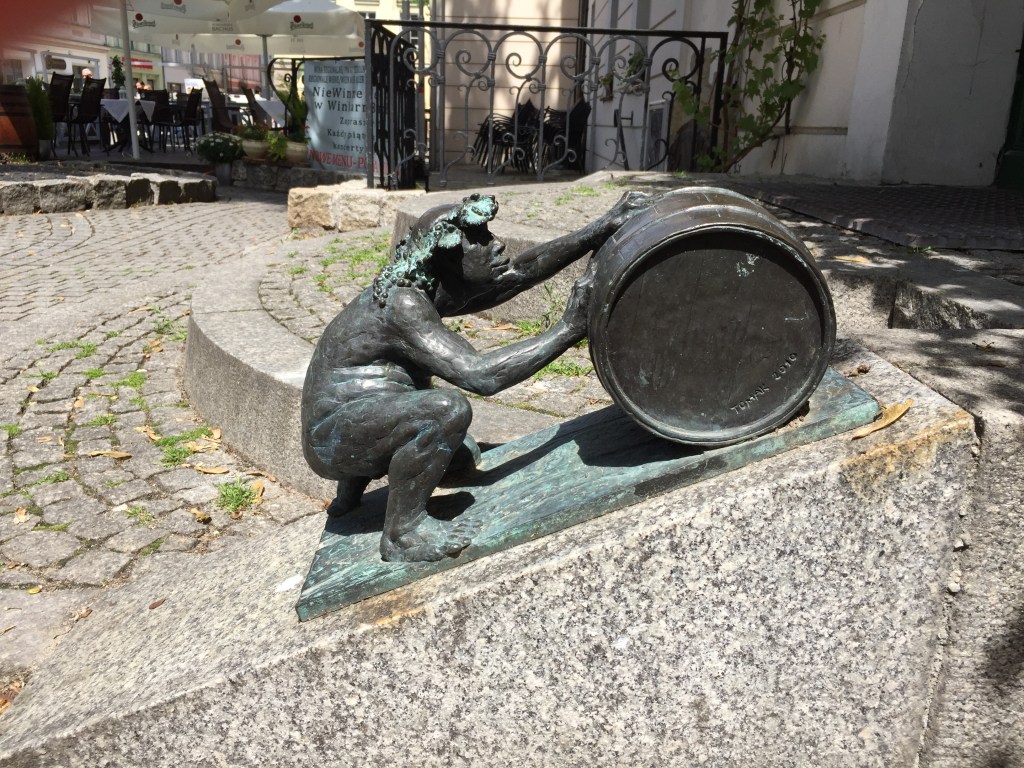
The town obviously takes great pride in its gardens and floral displays. And an added bonus; all around the centre are little drunk Bacchus Statues.
After wandering around for a couple of hours, we go to Aldi and purchase supplies for a picnic in Winny Park.
Accommodation: Qubus Hotel Zielona Góra
Then, we check into our hotel; Qubus Hotel Zielona Góra, and have an early night in preparation for tomorrow’s run. The hotel has pros and cons. It’s conveniently located, next to Winny Park. The price includes a very extensive breakfast buffet. Breakfast is served until 11 am at weekends, which was ideal for us because we could do parkrun and still get back in time for breakfast. However, everything is a bit flimsy; you could hear people walking around on other floors, the bed consisted of two single beds with a double mattress topper, which made it rather wobbly and the curtains were thin, so by 5 am our room was flooded with sunlight.
Zielona Gora Parkrun
It’s Saturday, AKA parkrun day, and the main reason for the trip; the old man running a parkrun beginning with Z. He booked a hotel right next to the park. Unfortunately, not the correct park – that’s two miles away.
We get ready and I set the SatNav for Zielona Góra parkrun. This takes us to the start – literally. The run takes place in a forest on the edge of town. We drive past the leisure centre and the car park, onto a dirt trail through the forest. After a few turns, we find the ‘start’ sign. We have accidentally managed to drive a lap of the course.
We retrace our route to an actual road, park up in an actual car park and return to the start on foot. Everyone is very friendly (there are four more British tourists). The route is two scenic laps of the forest trail. The sun is shining and it would have been a lovely morning.
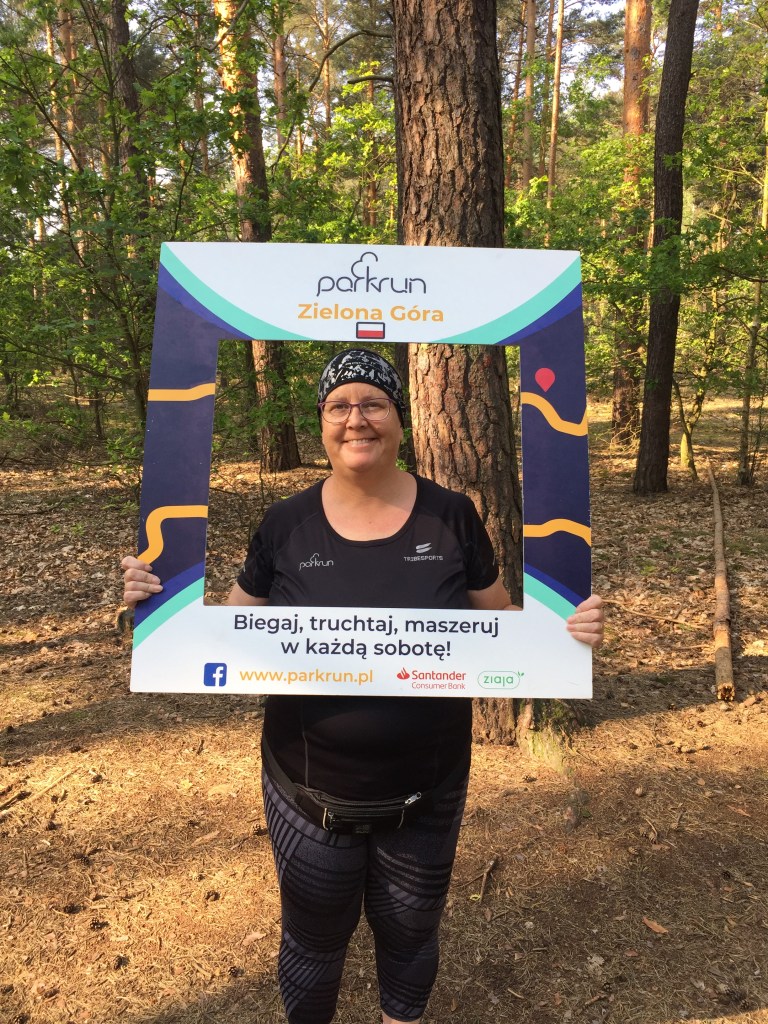
However, shortly before the finish, I trip and land flat on my face in the dirt, taking the impact on one knee. It hurts so much I want to cry. My Strava helpfully announces; “Activity paused”. It certainly has. I manage to get up and hobble across the line.
We return to Qubus and have breakfast with the other Brits. The somewhat eclectic buffet claims to contain 100 items. We briefly discuss if we can be bothered to count. Then it’s time to check out and hobble off to Berlin for our flight home.
- Trip taken: May 2019
- Updated: October 2025
I hope you found the above information useful. For guides to more destinations in the 50+ countries we have visited, check out my full list of Independent Travel Itineraries here.

 Jane's Midlife Journey
Leave a reply to Kraków: Top 10 Things to do – Jane's Midlife Journey Cancel reply